
J12 High Jewelry

Set with diamonds and brilliantly colored gemstones, these precious J12 variations feature sophisticated watchmaking expertise paired with the world of fine jewelry. An infinite expression of creativity by Chanel.
33 Strand Beach Drive


Once you step beyond the fully disappearing glass walls, to the ocean-facing terraces overlooking the surf and sand, you enter an environment of beach-front living to rival the best resorts in the world. With this home’s brilliant panorama of the blue Pacific and direct beach access, a more sublime surf-front oasis would be a challenge to discover. Art and artifacts, foliage and fossils - ancient and modern intersect to make this Balinese-style beach-front home arguably the most desirable property along The Strand. With more than 9,800 square feet of living space on three levels, the home grants seamless transition from indoor to outdoor spaces so ocean breezes can mix nonchalantly with heirlooms and architecture that enrich the home with a sense of understated sophistication and South Pacific ease. Renown architect Chris Light’s inventive approach to layout and design offer up a visual feast of inspiration and style starting curbside with its Jerusalem Limestone and Mahogany-trimmed exterior framing a secured courtyard entry with bronze “Buddha Hands” gate-pulls. The two-story foyer, with its mystical light fixture, unfolds to the main living areas and ocean-view office. The enchanting master suite, with dual bathrooms, opens to its private deck and panoramic ocean surf views – taking full advantage of the magnificent sunsets. Three additional bedroom suites and lounge are on the upper level. The lower level is an entertainment mecca – containing a wine area with 300-bottle display wall, movie area with full surround sound, fully-equipped bar, gym, sauna, steam shower, lounge seating area, powder room, and two outdoor living areas. The main-level open floor plan - blending dining, living, and entertaining areas - offers open access to the chef’s kitchen with its six-burner stove in front of a stunning blue onyx wall, separate full-sized refrigerator and freezer, double cooking islands, and is fully equipped with all imaginable amenities. Among the home’s distinctive features are mother of pearl tile walls, Limestone finishes, custom Mahogany trim and woodwork, Walnut plank flooring, woven bamboo ceilings, stainless steel beam accents, radiant heated floors, and Venetian plaster walls. Included in the outdoor space of this resort world are an infinity-edge swimming pool, spa, three fire pits, waterfall, direct beach access, beach shower, two outdoor lower-level lounge areas, and separate dog run and kids’ play area. Beyond the blend of organic elements lies a sophisticated backbone of integrated technology for convenient monitoring of the whole-house security, lighting, environment, and audio/visual systems of this exotic and refined ocean surf home.
Jean-Michel Basquiat IN THE WINGS
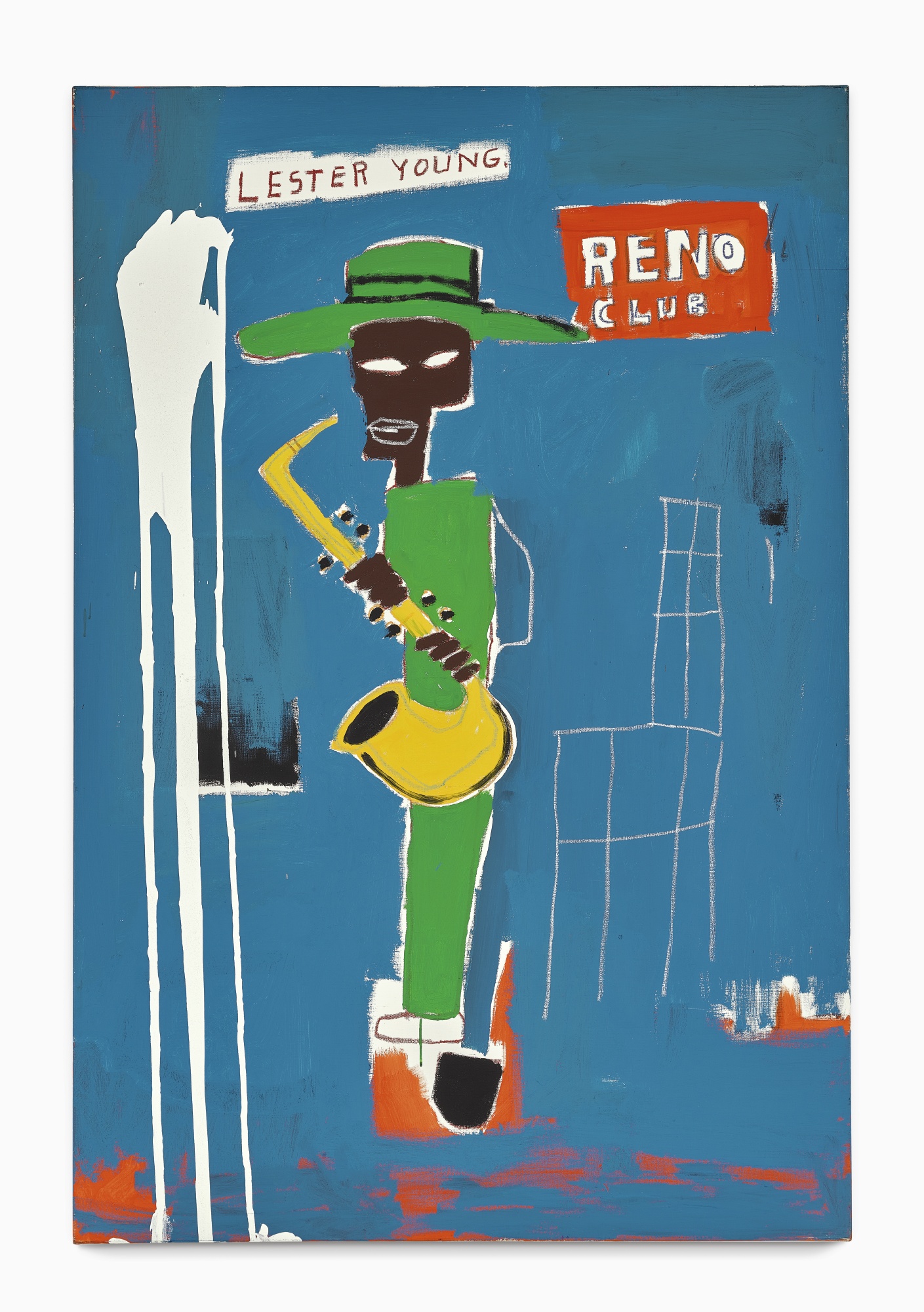
“Jean-Michel began to incorporate the names of these songs and the linear notes of the records, and mesh those words with images in his painting…He immortalized those records in a way that blended with his style and was very much a part of where he was coming from. But always with a twist and sense of humor.” (Fred Braithwaite, “Jean-Michel as Told by Fred Braithwait a.k.a. Fab 5 Freddy, An interview by Ingrid Sischy,” in Exh. Cat., Malaga, Palacio Episcopal de Malaga, Jean-Michel Basquiat, 1996, p. 155)
Painted in the crucial moment of 1986, just two years before his untimely death, Jean Michel Basquiat’s In the Wings is undoubtedly one of the most charismatic cultural portraits of his entire oeuvre. Adding to the limited number of important paintings that he dedicated to the greatest jazz legends of the Twentieth Century, here Basquiat enshrines the image of Lester Young – arguably the most influential and innovative saxophonists of all time – and creates a highly personal, devotional icon for posterity. Beyond paying homage to his musical idol, Basquiat instigates a cross-generational synthesis of artistic volition as the fluidly improvisatory tones of Young’s radical jazz are given a perfect visual counterpart in the painter’s unique gestural flare. Bearing a relatively pared-down composition, an enigmatic blue background and by focusing on a single African-American figure, In the Wings is stylistically emblematic of the important set of works created in the final years of Basquiat’s career in which he focused more heavily on Black subjects. By inducting Lester Young into his great pantheon of Black cultural icons, Basquiat seeks to reshape narratives on African American culture, whilst simultaneously positioning himself as contributor to its great legacy. Having acknowledged himself as a relative rarity as a Black artist within a racially homogenous art world, through In the Wings Basquiat destabilizes the canon of cultural history by inserting Black consciousness at its forefront and chiefly positioning himself as its visionary narrator.
From famous athletes such as Sugar Ray Robinson, Cassius Clay, Tommie Smith and John Carlos, to political figures including Malcolm X and Marcus Garvey, Basquiat’s oeuvre is punctuated by emphatic references to ground-breaking African American figures of the 20thcentury. Reverentially valorizing their successes in the face of staunch adversity and extreme racial prejudice, the historic development of American jazz music became Basquiat’s third arena in which to explore the rich and influential products of Black culture. Such as in the 1983 work Horn Players, now in the collection of the Broad Museum in Los Angeles, from early in his career Basquiat celebrated what Bell Hooks has described as "the innovative power of black male jazz musicians, whom he reveres as creative father figures," later proceeding to depict significant musicians such as Charlie Parker, Dizzie Gillespie, Ben Webster, Duke Ellington, Max Roach, Billie Holliday and Lester Young. (Bell Hooks, 'Altars of Sacrifice: Re-membering Basquiat' in Outlaw Culture: Resisting Representations, New York, 1994, p. 35) Painted in the same year and bearing the same blue backdrop as the present work, King Zulu (Barcelona Museum of Contemporary Art) is another work also dedicated to a founding feather of American Jazz, Louis Armstrong.
From the 1950s, as a predominately African American Art form, Be-bop Jazz revolutionized the trajectory of music by privileging a highly expressive and improvised approach that finds a replete parallel in Basquiat’s painterly freedom. With individualism and experimentation at the heart of jazz music, each of Basquiat’s jazz heroes maintained a distinctive vocal or musical style, making unique artistic contributions to the development of the genre. Starting as an innovative member of Count Basie's band in Kansas City in the mid 1930s, Lester Young is one such figure who redefined jazz through his sensual refinement of Swing music. In the present work, Basquiat ultimately mirrors the relaxed tone and sophisticated harmonies that set Young’s music apart from his contemporaries in the supreme formal balance that also retains a sense of energetic improvisation. Compared to the densely frenetic compositions of the early 1980s, here we see a wise and confident Basquiat carefully selecting references and techniques – marrying style and content – to offer a highly particular vignette.
Young was well known for the unorthodox manner in which he positioned his saxophone as he played. Emerging from a brilliant blue backdrop, Basquiat privileges this detail with the contrasting yellow glare of the centralized instrument. Grasped by the dandyishly styled Young in a vibrant green suit and wide-brimmed hat, the charismatic musician is spot-lit and center stage in the composition. Surrounded by the stupefying abstract rhythms of the artist’s brush, a visceral cascade of gestural white paint down the left edge of the picture provides a synesthetic evocation of free flowing sound. Yet, whilst the canvas chimes with the exuberance of a live performance, Basquiat’s use of text and his characteristic insistence on two-dimensional depiction seems to intimate a promotional poster or perhaps a record cover, as his immediate frame of reference. Having died in 1959, Basquiat’s evocation of the “Reno Club” refers to an original live recording made there in Kansas city in 1936; one of the many Jazz records that provided an inspirational score against which his distinct subjective visions were created. Basquiat’s expedient rise to success had come through his fresh presentation of a diverse mélange of cultural influences, from graffiti tags to comic books and even food packaging. Here he simplified his unique symbolic lexicon to focus on one favored moment in the history of jazz.
Whilst Lester Young was known for having popularized much of the jazz ‘hipster jargon’ associated with the genre, here Basquiat evades his own characteristically ambiguous use of words, privileging instead their ability to designate the specific moment. This open stage allows Basquiat to bathe his central icon in a fittingly lyrical abstraction that shows the full range of his transcendent technique as both a painter and draughtsman. As Robert Farris Thompson describes, Basquiat consciously enters into a nuanced dialogue with his painterly predecessors: "Basquiat himself did not parody Abstract Expressionism, as Pop Masters sometimes did. As he fused his sources, his mood was more complex: humour, play, mastery, and stylistic companionship. He brought into being first-generation (Kline) and second-generation (Twombly) Abstract Expressionist citations and mixed them up amiably with cartoon, graffitero, and other styles." (Robert Farris Thompson, 'Royalty, Heroism, and the Streets: The Art of Jean-Michel Basquiat' in Exh. Cat., New York, Whitney Museum of American Art, Jean-Michel Basquiat, 1992, p. 36) Whilst the luscious drips of free-flung white provide a nod to Jackson Pollock, the whimsically minimalist scrawl of the white squares that suggest a chair seem to toy with the authority of the minimalist grid, promulgated by Sol LeWitt, Donald Judd and Agnes Martin. Invigorating the background with a static red that demarcates form and bleeds through in the manner of both Robert Motherwell and Clyfford Still, Basquiat usurps the authoritarian schools of painting that dominated American art until his arrival upon the New York scene, whilst responding to the revolutionary aural experience of Young’s music.
Crucially, Basquiat’s highly abstracted treatment of Young’s face brings to light the intersection of race, representation and culture that underscore the painting. Composed of a rich mahogany brown, the highly stylized eyes and naively emphasized lips take a dually provocative role by recalling both the resounding influence of African art on modern masters such as Picasso, as well as the unsettling aesthetics of minstrelsy and the archaic racial stereotypes that once permeated American visual culture. As surmised by cultural theorist Dick Hebidge "… in the reduction of line into its strongest, most primary inscriptions, in that peeling of the skin back to the bone, Basquiat did us all a service by uncovering (and recapitulating) the history of his own construction as a black American male." (Dick Hebidge, "Welcome to the Terrordome: Jean-Michel Basquiat and the Dark Side of Hybridity," in Exh. Cat., New York, Whitney Museum of American Art, Jean-Michel Basquiat, 1993, p. 65) In his tribute to Lester Young, on one level Basquiat gives aesthetic form to the revolutionary rhythms of jazz as a means of celebrating the legacy of Black culture and the historic achievements of Black artists. However, in also considering African American identity at the intersection of personal experience and a set of performative masks, he has immortalized his own subjectivity within the canon of cultural consciousness.
McClean Design- Sunset Strip





Sunset Strip
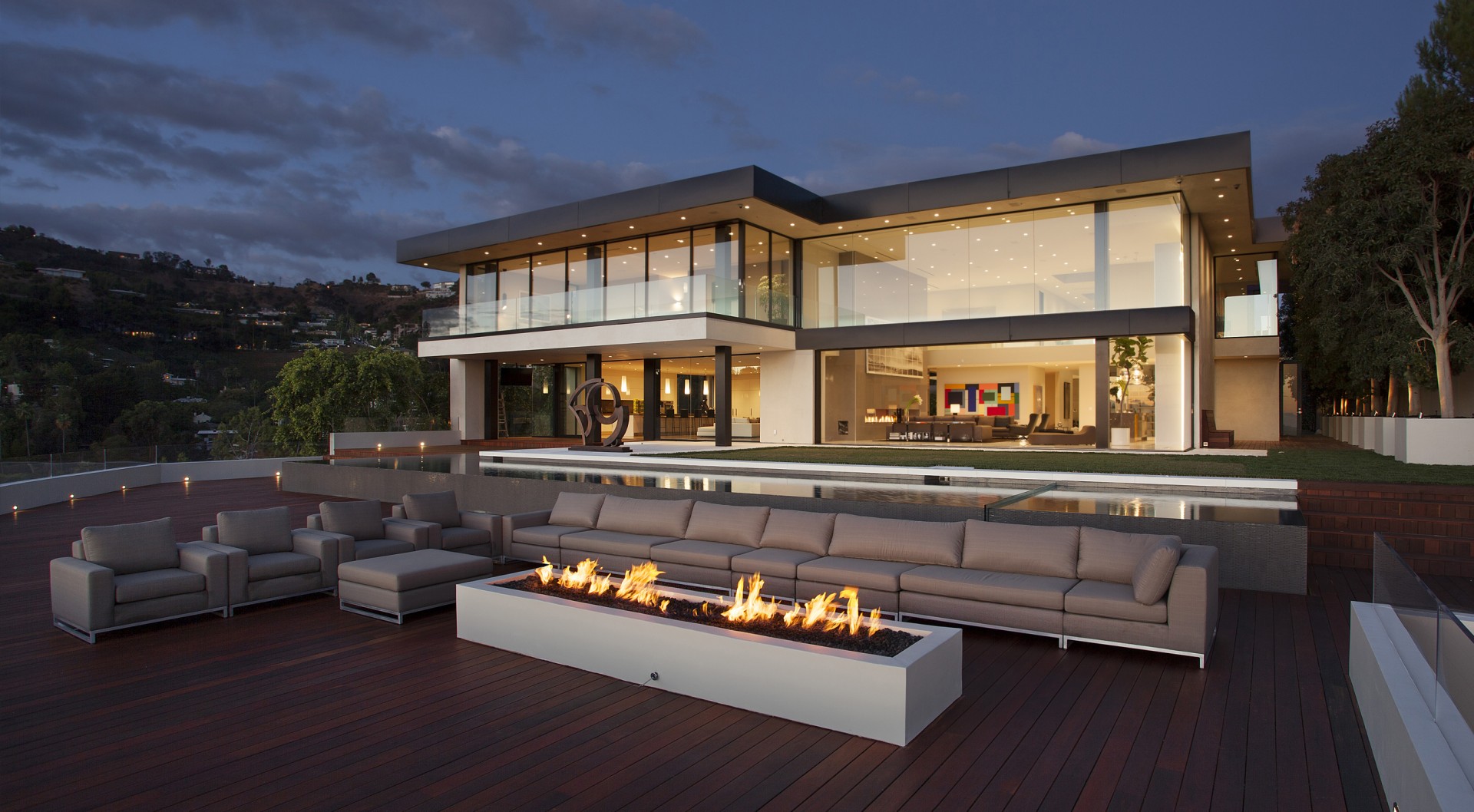
The house is approached by means of a gated driveway and guard house. Passing through the gate a landscaped hedge leads to the drive court which is centrally located between the house, garage, and guest house. The garage sits in a spot that enjoys spectacular views of the surrounding canyons so we designed it to be glazed on both sides. All three buildings are connected by a water feature that leads the eye to a pool and spa at both ends. The main house is approached along the water feature by means of a short stair which leads to the front hallway, glazed and open on three sides with room for a significant art piece on the focal wall. The entry leads to a stairwell where a beautiful chrome and stone stair ascends to the upper level bedrooms. Directly ahead is the living room, doors open to the right where the dining room is located overlooking the water feature. To the rear, tall suede door lead to the library/ informal media room where pocketing doors access a private landscaped garden. An interesting feature of this room is that the same film is projected on both sides of the drop down screen allowing people to circle around and watch from both inside and out.
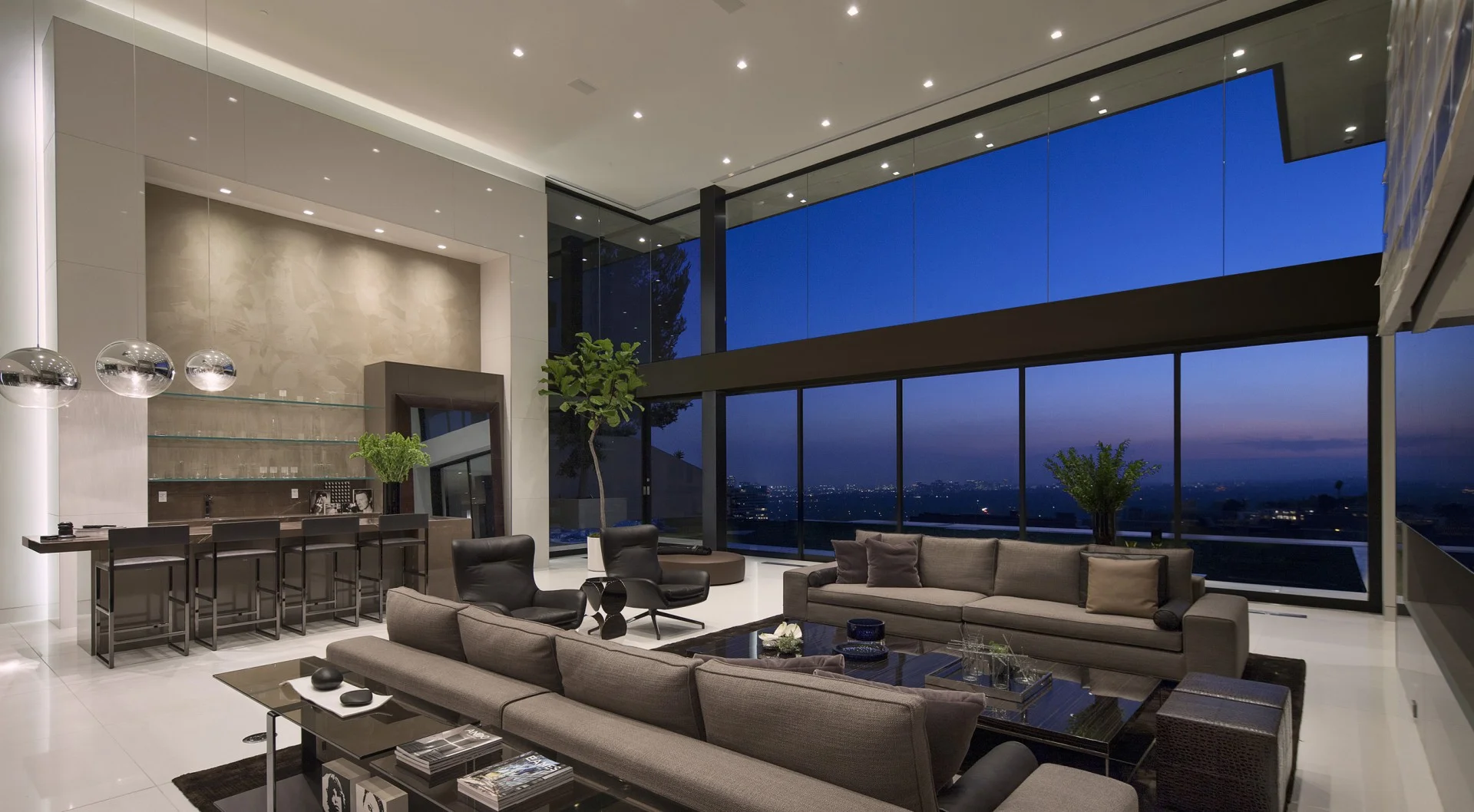
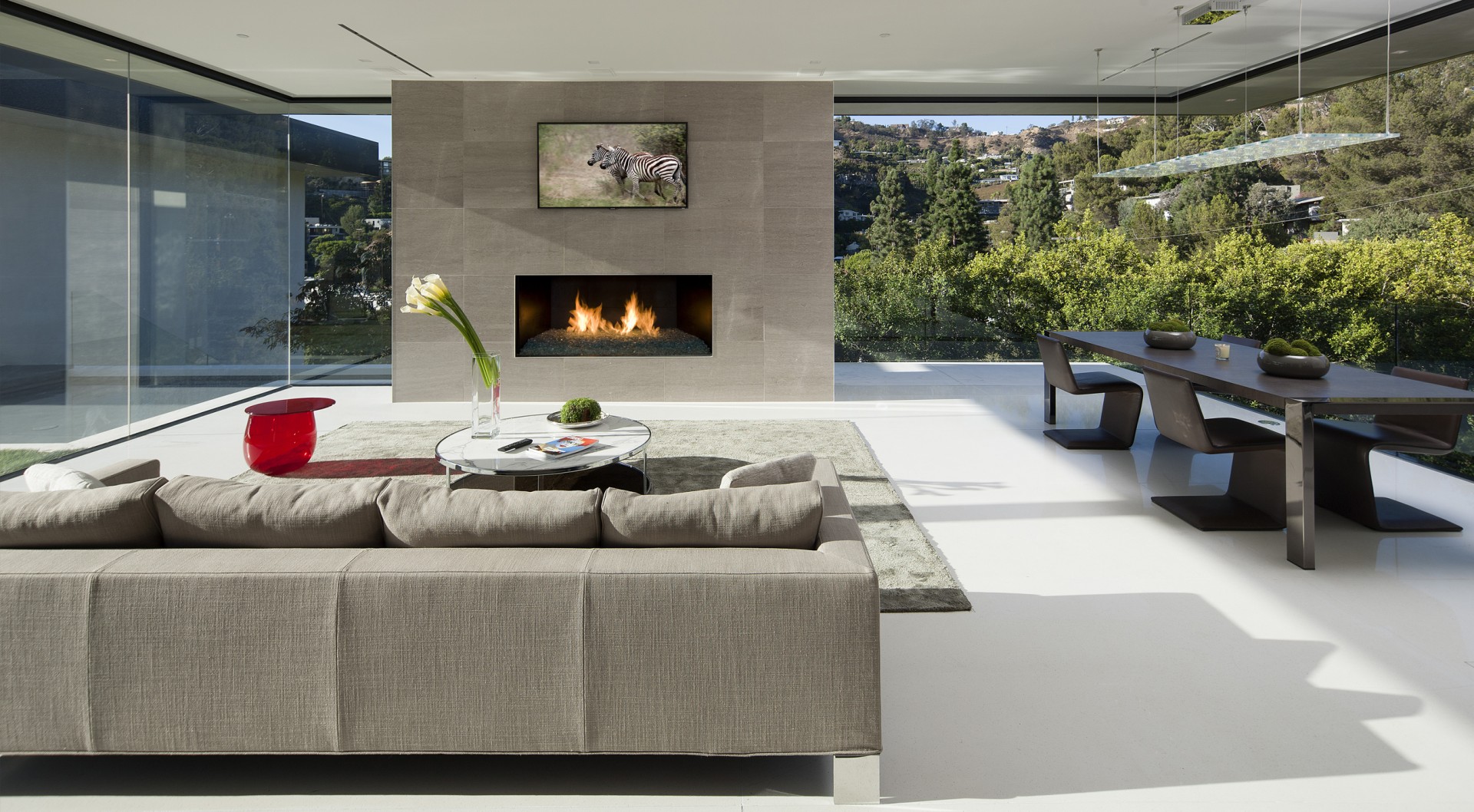
The main living room is two stories tall and enjoys spectacular views of the Los Angeles Basin and the ocean beyond. The room incorporates a bar and glazed wine cellar as well as an elongated see through fire place that is visible from the family room on the other side. The combined kitchen and family room has a more intimate feeling than the living room and appears to float over the water feature. From here it is possible to look back along the water past the garage all the way to the guest house and beyond. This room also enjoys wonderful views of the city below and leads directly to the back yard, covered dining area and expansive elevated terrace below the infinity pool. This terrace is designed for entertaining large groups and incorporates an extended fire feature and comfortable seating. This level of the house is completed by services spaces and an office for the owner.
Below the main level are two large bedroom suites each with their own outdoor area. Across the lower courtyard is the gym and wellness center. Located directly below the garage it incorporates sliding walls of glass to make the most of the mild climate. The upper level of the house contains the master as well as two additional bedrooms. At the top of the stairs there is a gallery space that looks into the living room below and out to the water feature. The master bedroom itself has his and her bathrooms complete with large closet areas. The sliding panels of glass surrounding the bed and sitting area open automatically to the deck which reveals the best view of the house enjoyed by this room. The other two bedrooms are expansive and have their own walk in closets and separate baths.
Across the drive court from the main house a separate and independent guest house contains two bedrooms, living, dining and kitchen and its own services spaces. The palette of materials is designed to be warm and contemporary. We have made extensive use of polished stone and added wood elements for warmth. All kitchens and bathrooms in corporate Italian furniture and fixtures, windows and doors are bronzed aluminum. The house is located in one of Los Angeles most famed neighborhoods, only minutes from Sunset Strip yet still enjoying a piece and serenity made possible by the surrounding nature.
Home Libraries (Sotheby's)
byIyna Bort Caruso | 04 Aug 2017


A personal library is not just a room – it’s a realm. No other space offers as much insight into a person’s tastes and intellectual curiosity, or feels as intimate and consequential at the same time.
Such is the case in Newport, Rhode Island, where the centrepiece of a sprawling condominium is a library with vaulted cedar-shingled ceilings, cherry and mahogany millwork, as well as an imposing fireplace. Made of three units combined into one, the home is located in a former 1852 carriage house that was once part of an estate owned by John Jacob Astor. A meticulous 21st-century reimagining of the space where coachmen once met, its library looks strikingly authentic to both the building’s former self and the current owners’ personalities. “People enter the library and are just awestruck,” says Kate Kirby Greenman of Gustave White Sotheby’s International Realty in Newport. “It’s very peaceful, very beautiful, and it just takes your breath away,” she adds. Measuring 30 square feet, this cherished haven is as ideal for entertaining as it is for quiet contemplation.
Clearly, even in our digital world, the idea of a space dedicated to hardcover books remains extremely appealing. For her part, architect Susan Bower of Mitchell Wall Architecture and Design in St Louis, Missouri, loves “the way you can manipulate space with books” – use freestanding bookcases, and they become sculptures; line a room with books, and they give the impression of wallpaper, as in the majestic contemporary library of a family home in Heber City, Utah. “A library has all these ideas captured between bindings – it’s just a wonderful repository of human thought,” Bower says. It can also be an impressive reflection of your best self.
Ao Yun

A blend of 90% Cabernet Sauvignon and 10% Cabernet Franc, this is a bold, dramatic and compelling debut wine from winemaker Maxence Dulou. Particularly impressive is the strong sense and imprint of place which is partially revealed by its saturated colour, exquisite ripeness, silky, grainy tannins and exciting freshness. The palate also provides sweet black and red cherry fruit overlaid with cool graphite, camphor as well as notes of juniper, pepper and cumin. Most surprising of all is the 15.1% alcohol which is both balanced and well hidden in the texture and freshness. It’s difficult to predict how long the wine will age and develop. But all the elements are there for a long and happy life.
Read more at http://www.decanter.com/reviews/china/ao-yun-2013/#PtHKJ67U8bYCAILP.99
Joan Mitchell- NO ROOM AT THE END
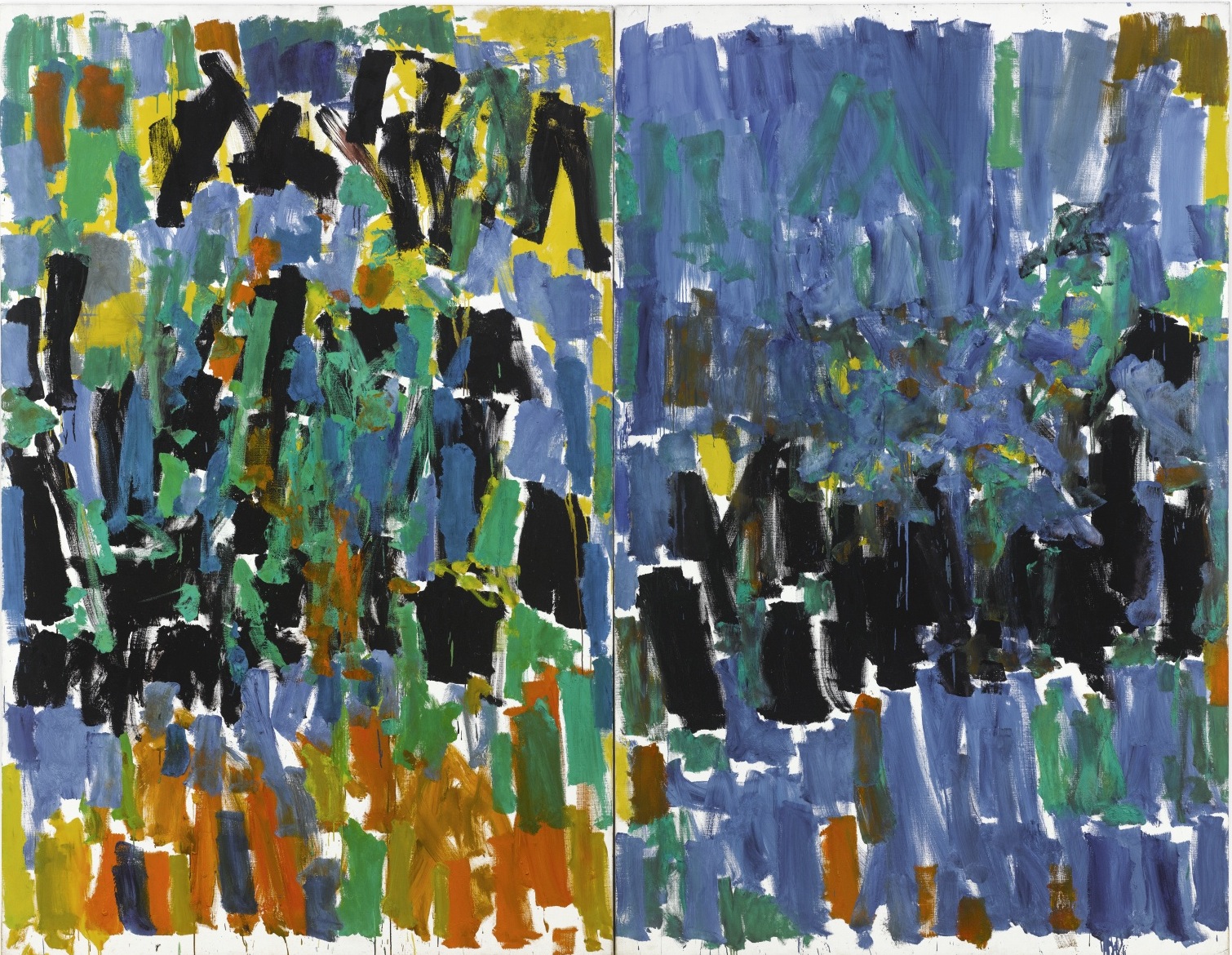
“In terms of sheer largeness of vision, of solving painterly problems with an almost incredible audacity, these oversize pictures from the 1970s have few rivals in all of modern American painting…It can be argued that these works mark Mitchell’s ascendancy to a level that few artists have attained, an achievement that would set the stage for her work to come” (Jane Livingston, ‘The Paintings of Joan Mitchell’, in: op. cit., 2002, p. 35)
Triumphantly heralding an irrepressible joie de vivre, No Room at the End is an arresting testament to the visual dynamism and profound emotive force of Joan Mitchell’s inimitable painterly oeuvre. A magnificent example of her commanding paintings of the late 1970s, the densely layered surface of the present work powerfully evokes the lush countryside of the artist’s home in Vétheuil, engulfing the viewer in a sensory tide of blooming countryside. Simultaneously, coursing across the monumental dual canvases, Mitchell’s impassioned strokes reveal an emotive intensity that transforms the riotously abstract painting into a vessel of profound self-expression. Reflecting upon the intimately personal nature of Mitchell’s practice, poet Nathan Keman notes that Mitchell’s paintings reveal an “attention to the most fleeting sensations; to her feelings; to remembered images of landscape, which she carried with her and which she re-visualized as marks made on canvas.” (Exh. Cat., New York, Cheim & Read, Joan Mitchell: The Presence of Absence, 2002, n.p.) A visual tour-de-force of color, gesture, and exhilarating painterly bravura, No Room at the End is wholly demonstrative of an artist at the apex of her expressive painterly abilities.
Executed on a truly monumental scale, No Room at the End constitutes a remarkable sensory engagement with the artist’s beloved countryside home in France. Founded in a visionary love of nature, combined with a painterly idiom rooted in abstraction, Mitchell’s oeuvre forged a conceptual union between the gestural canvases of the American Abstract Expressionists and the profoundly rich painterly idioms of the European Impressionists. Although Mitchell spent the first years of her career as a female painter within the predominantly male New York School, her relocation to Paris in 1959, then to the countryside of Vétheuil in 1968, afforded her the critical conceptual distance and creative freedom to create her own, utterly unique artistic practice. The artist’s home, surrounded by an expansive garden in which Mitchell planted sunflowers and other vibrant blossoms, brought an inimitable sense of joy to the paintings she executed between 1968 and the late 1970s. Mitchell’s biographer Patricia Albers declares, “From the time she acquired Vétheuil, its colors and lights pervaded her work. Loose allover quilts of limpid blues, greens, pinks, reds, and yellows… fairly burble, their colored lines and shapes registering a painter’s fast-moving hands as they rise steeply, floating between inner and outer worlds, to jostle and bank at their tops.” (Patricia Albers, Joan Mitchell: Lady Painter, New York, 2011, pp. 313-314) The abundant natural beauty of the French countryside is powerfully embodied in the vigorous layering of dense, jewel-toned pigment in the present work; rendered with an energetic gestural gusto, lush swaths of sunflower yellow, shimmering blue, and a subtle, earthy orange bloom across the monumental canvas to surround the viewer in the fragrant atmosphere of a springtime garden. The result is a composition evocative of the painterly abandon of de Kooning, the luminous vibrancy of Francis, and the exquisite specificity of Monet.
In their unapologetic vitality, Mitchell’s monumental works of the 1970s number among the most striking and painterly examples of the artist’s career. The sheer size of the present work, which spans almost twelve feet in width, testifies to the confidence and ambition of Mitchell’s artistic practice following her move to Vétheuil; indeed, unlike her Frémicourt studio, where oversized canvases had to be rolled in order to enter and exit the space, therein preventing the artist from covering her canvases in layers of sumptuous impasto, the high-ceilinged workspace in Vétheuil afforded the artist ample room to execute her towering theses on abstraction. While Mitchell’s earlier paintings interspersed vivid pigment with areas of blank canvas, the lush density of the present work is echoed in other monumental paintings of the same year, such as Rosebud, in the collection of the Albright-Knox, and Posted, held by the Walker Art Center; prefiguring her celebrated La Grande Vallée series of the early 1980’s, Mitchell’s swift, vigorous and thick mark-making in these paintings culminates in a luminous and buoyant image. Jane Livingston aptly reflected on this decisive transition in the artist’s oeuvre: “In terms of sheer largeness of vision, of solving painterly problems with an almost incredible audacity, these oversize pictures from the 1970s have few rivals in all of modern American painting… It can be argued that these works mark Mitchell’s ascendancy to a level that few artists have attained, an achievement that would set the stage for her work to come.” (Exh. Cat., New York, Whitney Museum of American Art, The Paintings of Joan Mitchell, New York, 2002, p. 35)
Consistent with Mitchell’s celebrated work of the 1970’s, the mesmerizing mixture of thick, emotive swathes of paint and looser, more spontaneous drips and strokes exhibited in No Room at the End suggests a corresponding progression towards greater emotional depth on the part of the artist. Noting this shift in the artist’s oeuvre, Klaus Kertess notes, “In 1975, Mitchell began to blur and bury the rhythmic rectangularity of her work in a heavily impastoed opacity, and then released an unremitting rain of strokes that engulfed most of her paintings, through 1984, in a passionately pulsing ‘alloverness.’ The larger size and scale mastered in the first half of the seventies now acquired greater visual and emotional depth. As she reached the age of fifty, her sense of wonder in nature not only remained intact but continued to expand, while her fear and rage at human loss had hardly subsided…Mitchell’s paintings now took on the full ripeness of maturity; furious intimacy gave way to a fuller understanding that her aloneness was as universal as it was uniquely personal. Her remembrances became more sonorous and varied.” (Klaus Kertess, Joan Mitchell, New York, 1977, pp. 34-35) Underlying the luminous blues and yellows of the present work, Mitchell’s thick black strokes instill No Room at the End with the poignant rhythm of experience, grounding the otherwise effervescent composition in maturity. In her unrepentant emphasis upon mark, each stroke retaining its autonomy whilst corresponding to a larger cohesive image, Mitchell’s canvas recalls the psychical intensity of van Gogh’s landscapes of the 1880’s. Of Mitchell, Kertess notes, “From painting to painting, there was a greater variety of color, mood, and format. The indivisibility between the strokes as a unit of visual structure and the stroke as a unit of intertwining natural and emotional forces reflects the influence of van Gogh, the powerful directness of his mark making that merged the seen with the felt.” (Klaus Kertess, Joan Mitchell, New York, 1977, p. 35) This intensification of emotive and painterly force is exemplified in No Room at the End as, in a joyful comingling of hues and texture, Mitchell renders the lush vibrancy which surrounded her; it is as if the sumptuousness of both sentiment and pigment has exceeded the canvas’ ability to hold them and they have burst free, coursing down the canvas face in a rain of pictorial dynamism.


Villa Brown Jerusalem


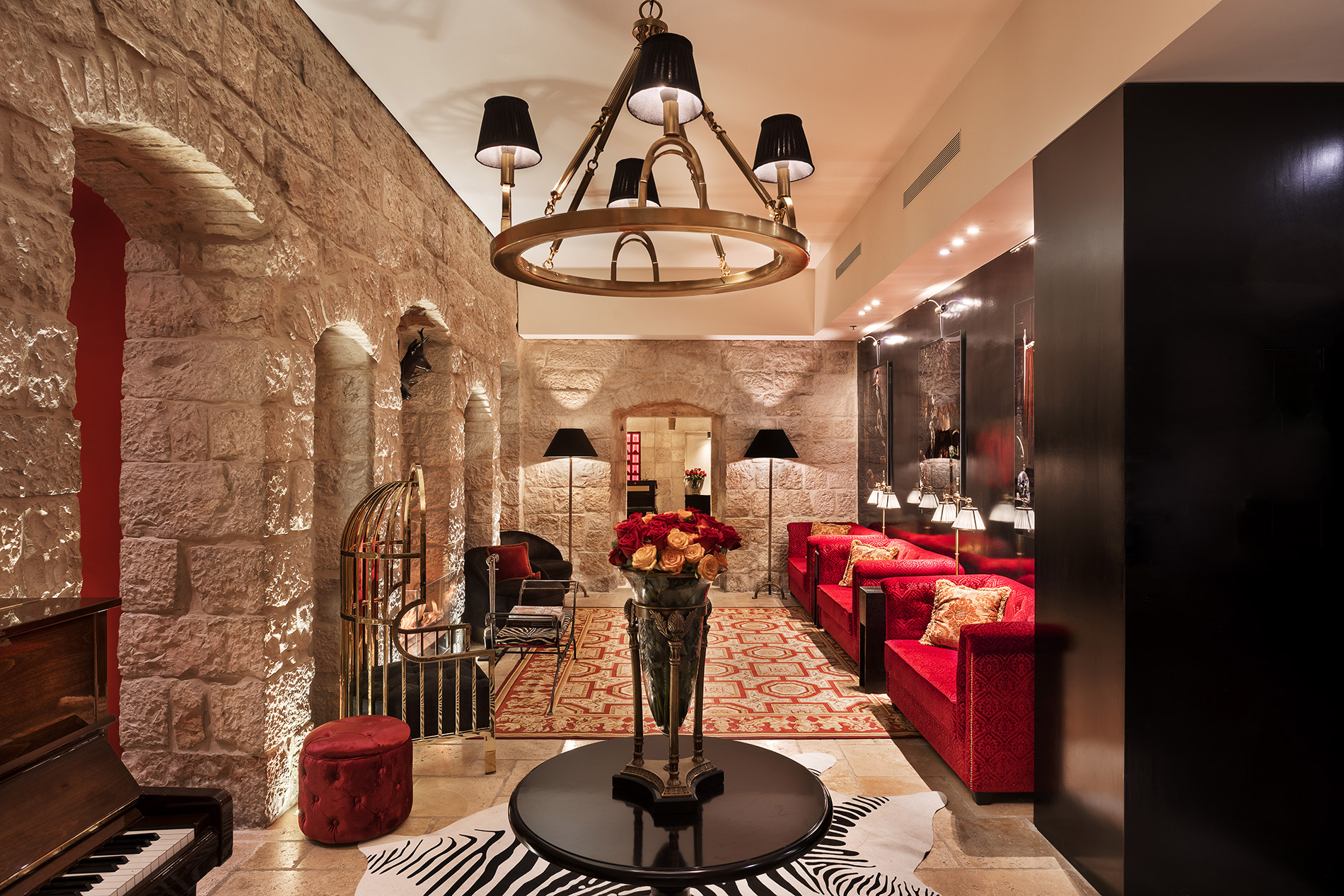
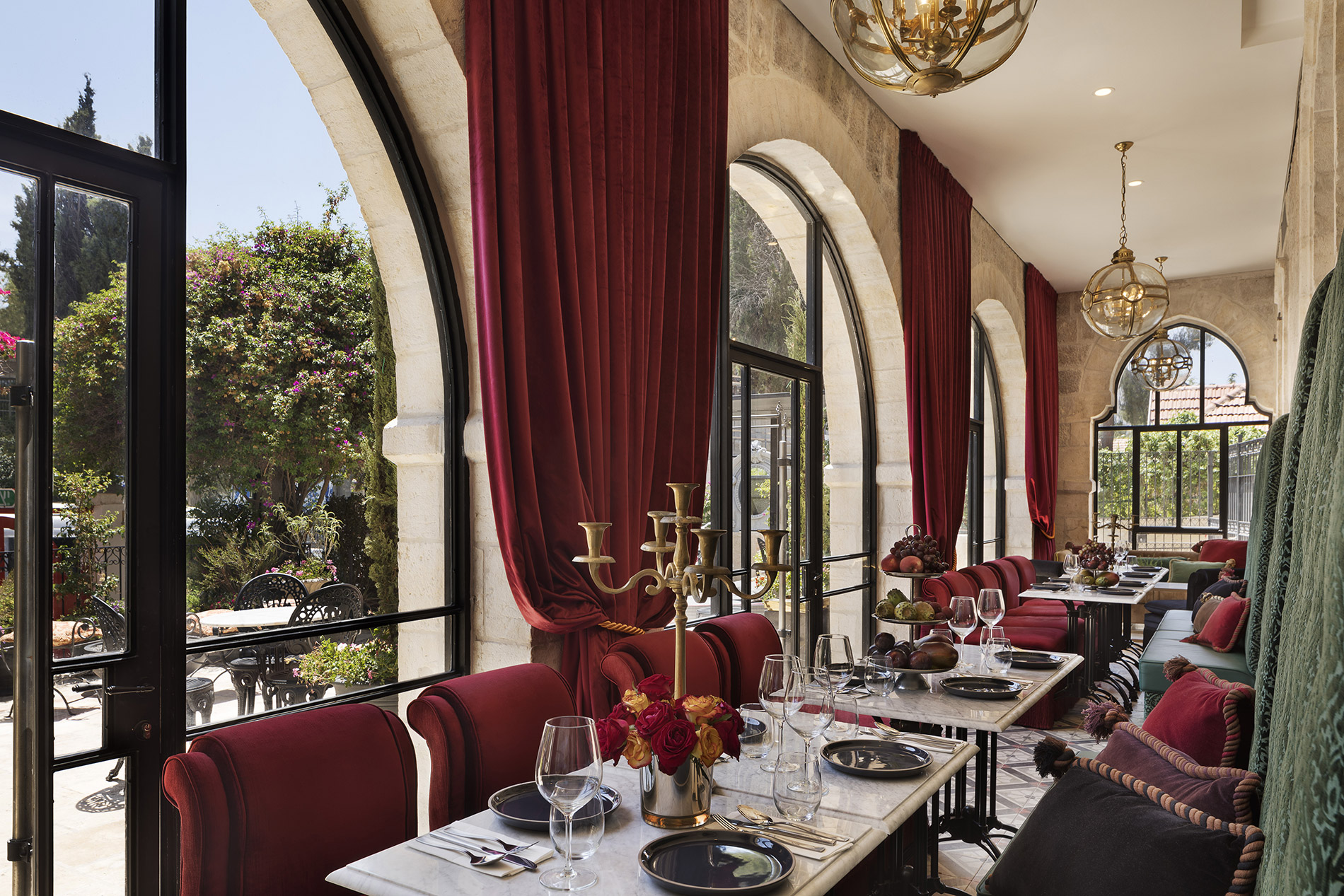


The new Villa Brown Jerusalem introduces contemporary boutique hospitality to the ancient city of Jerusalem, Israel. It resides in a renovated picturesque 19th century villa in the heart of Jerusalem, next to the Russian compound and overlooking the Ethiopian church. It is merely a 5 minutes’ walk to the old city walls and right by the city center, on 54 Ha'Neviim Street.
The villa was originally built as the family home of a wealthy Jewish doctor who served as the general manager of the Rothschild hospital in Jerusalem. Considered one of the most impressive in the area, the villa housed receptions and balls, and served as a meeting point for the local elite. It has now been fully renovated and two extra floors were added with services and facilities required to meet the needs of the savvy modern traveler. The hotel features 24 plush rooms and suites, a garden bistro-café, rooftop spa and terrace, meeting room, library and a unique underground "Cave Bar" located at the old water well underneath the house. DURING THE OPENING PHASE, SOME OF THE HOTEL’S AMENITIES MAY NOT FULLY OPERATE.
Villa Brown is a member of Brown Hotels , an international hotel brand founded in Tel Aviv, with sister hotels located in the city of Tel Aviv (the world acclaimed Brown TLV, Brown Beach House, Poli House and more hotels opening soon) and Trogir, Croatia (Brown Beach House Croatia). The Brown properties are all rooted in a devotion to service, design, innovation, style and authenticity, and are often recommended by the world's leading lifestyle, design and travel publications.
Address: 54 Ha'Neviim St. Jerusalem
Tel: +972-2-5011555
Email:villa@brownhotels.com