
Canaves Oia Hotel


On the northern part of the cosmopolitan town of Oia in Santorini, lies hidden a well-kept secret. EPITOME is located right out of the main town, above the picturesque
fishing town of Ammoudi. A serene location awaits those who are ready to experience Santorini from another perspective. Relish the sunset, admire the views and feel the dreamy and relaxing ambience that EPITOME comes to off er .

São Lourenço do Barrocal


São Lourenço do Barrocal is a hotel and monte alentejano, located in a wild corner of the Alentejo, Portugal, in the foothills of medieval Monsaraz and nearby the Alqueva lake.
Within a 780-hectare estate that has been in the same family for over 200 years, it has its heart at an ancient small farming village, which has been brought back to the rhythms of rural daily life as a remarkable hotel of understated luxury, set amidst ancient holm oaks, olive groves and vineyards.
Here, all the comforts of a contemporary lifestyle are cultivated so guests can have the utmost experience while staying on a working farm, in communion with nature, heritage and people of all ages, being part of a budding community.
São Lourenço do Barrocal comprises a winery for the creation of its first-class single-estate wines, a farm to table restaurant respecting the flavour and simplicity of the food of Alentejo, a farm shop selling Portuguese contemporary crafts, regional delicacies and the estate’s own produce and a spa by Susanne Kaufmann, the renowned Austrian brand of organic treats. It also features an outdoor pool, an organic vegetable garden and orchard, stables with a horse
riding ring and a set of indoor and outdoor activities.
THE HOTEL SÃO LOURENÇO DO BARROCAL
Our 40 key five-star hotel offers beautiful accommodation – 22 guest rooms, 2 suites and 16 cottages –, where guests can enjoy the laid-back natural atmosphere and evidence the quiet heritage of ancient farm buildings and local craftmanship.
5 Winery Rooms - These rooms (50 to 85 sq. m.) are located on the pathway to the winery, offering views of the grain silos and/ or the reflecting pool. They include an antechamber, bathroom with bathtub, two washbasins and underfloor heating, a generously sized desk and a reading chair. Some of the rooms give access to an outdoor terrace (15 to 20 sq. m.) which features garden furniture and pergola shading.
5 Courtyard Rooms - Overlooking one of the most beautiful courtyards of the ‘monte’, with a reflecting pool, and the landscape of Monsaraz, these rooms (60 to 65 sq. m.) include an antechamber, bathroom with shower cabin and/ or bathtub, two washbasins and underfloor heating. All rooms contain a generously sized desk and a reading chair and give access to a private terrace (25 sq. m.) which features garden furniture and pergola shading.
12 Farm Rooms - These rooms (50 to 60 sq. m.) have the entrance in the main street of the ‘monte’ (for the most part), marking the former homes of the farm workers and their families. They include an antechamber, bathroom with shower cabin and/ or bathtub, two washbasins and underfloor heating, a generously sized desk and a reading chair. Rooms give access to a private terrace (25 to 35 sq. m.) which features outdoor furniture and pergola shading.
2 Suites - With privileged access to the surrounding landscape and a spectacular view towards Monsaraz castle, each suite (90 sq. m.) includes a living room with sofas, coffee table and dining table for 6 people. The bedroom contains a generously sized desk and a bathroom with shower cabin and a freestanding bathtub, two washbasins and underfloor heating. They also offer an outdoor terrace with view to a reflecting pool.
1 One-bedroom Barn Cottage - This cottage (175 sq. m.) has an outdoor terrace (60 sq. m.), offering views to the countryside, the old sheep pen and to the life unfolding in the ‘monte’. Its spacious bedroom contains a bathroom with shower cabin and freestanding bathtub, two washbasins and underfloor heating. It comprises a living room, a fully equipped kitchen with Gaggenau and Smeg appliances and a dining area with a table for 6 people, with access to an inner courtyard.
4 Two-bedroom Yard Cottages - Overlooking the gentle hill in the background of the rooftops or the other farm buildings, these cottages (135 to 190 sq. m.) are privileged places for connecting with life in the ‘monte’. Each one has 2 bedrooms (each with a private bathroom), a spacious living room with sofas, television and coffee table, a fully equipped kitchen with Gaggenau and Smeg appliances and a dining area with a table for 6 people. Some give access to an outdoor terrace (13 sq. m.), which includes garden furniture and pergola shading.
3 Two-bedroom Barn Cottages - These cottages (150 to 190 sq. m.) offer ample spaces, filled with natural light, reflecting their former use as barns, stables or cowsheds. They have 2 bedrooms (each with a private bathroom), a spacious living room with sofas, television and coffee table, a fully equipped kitchen with Gaggenau and Smeg appliances and a dining area with a table for 6 people. Cottages give access to an outdoor terrace (10 to 40 sq. m.), which includes garden furniture and pergola shading.
6 Two-bedroom Meadow Cottages - These cottages (155 to 175 sq. m.) have private outdoor terraces (40 to 120 sq. m.), offering unrestrained views to the ‘barrocais’ landscape and its wild meadows. Each cottage comprises a spacious living room with sofas, television and coffee table, a fully equipped kitchen with Gaggenau and Smeg appliances and a dining area with a table for 6 people. Each one of its 2 bedrooms include a bathroom, with shower cabin or bathtub and underfloor heating,
2 Three-bedroom Barn Cottages - Single or two-storey, these cottages have large areas (185 to 220 sq. m.), and unique features for hosting families or groups of friends. They give access to an outdoor terrace (30 to 85 sq. m.), offering views to the countryside and to life unfolding in the ‘monte’. They comprise bathrooms with shower cabin or bathtub and underfloor heating, a spacious living room with sofas, television and coffee table, a fully equipped kitchen with Gaggenau and Smeg appliances and a dining area with a table for 6 people.

The Edge

The edge defies both convention & gravity. Clinging to the side of a 500ft sea cliff in Uluwatu, Bali. The edge is one of Bali’s new breed of ‘Super Villas’ and promises its guests a chance to experience opulence, seemingly at the very edge of the world. Our Butler team are trained at Magnums Butler Academy, and provide dedicated, 24-hour service to guests. Butlers are on hand to manage guest’s requests and act as a personal assistant and concierge for the duration of the guests stay.
Secret Wonder by Harry Winston


Reversible starburst drops bring an enchanting and unexpected touch to an extraordinary pair of earrings. The versatile design features a brilliant medley of round and pear shaped diamonds on one side, and rotates to reveal a colorful array of sapphires, diamonds, and aquamarines hidden on the other side.
18 round brilliant sapphires weighing a total of approximately 0.84 carats, 8 pear-shaped aquamarines weighing a total of approximately 0.45 carats, and 438 marquise, pear-shaped and round brilliant diamonds weighing a total of approximately 7.43 carats, set in platinum.






The Art of de GRISOGONO
Creation 1
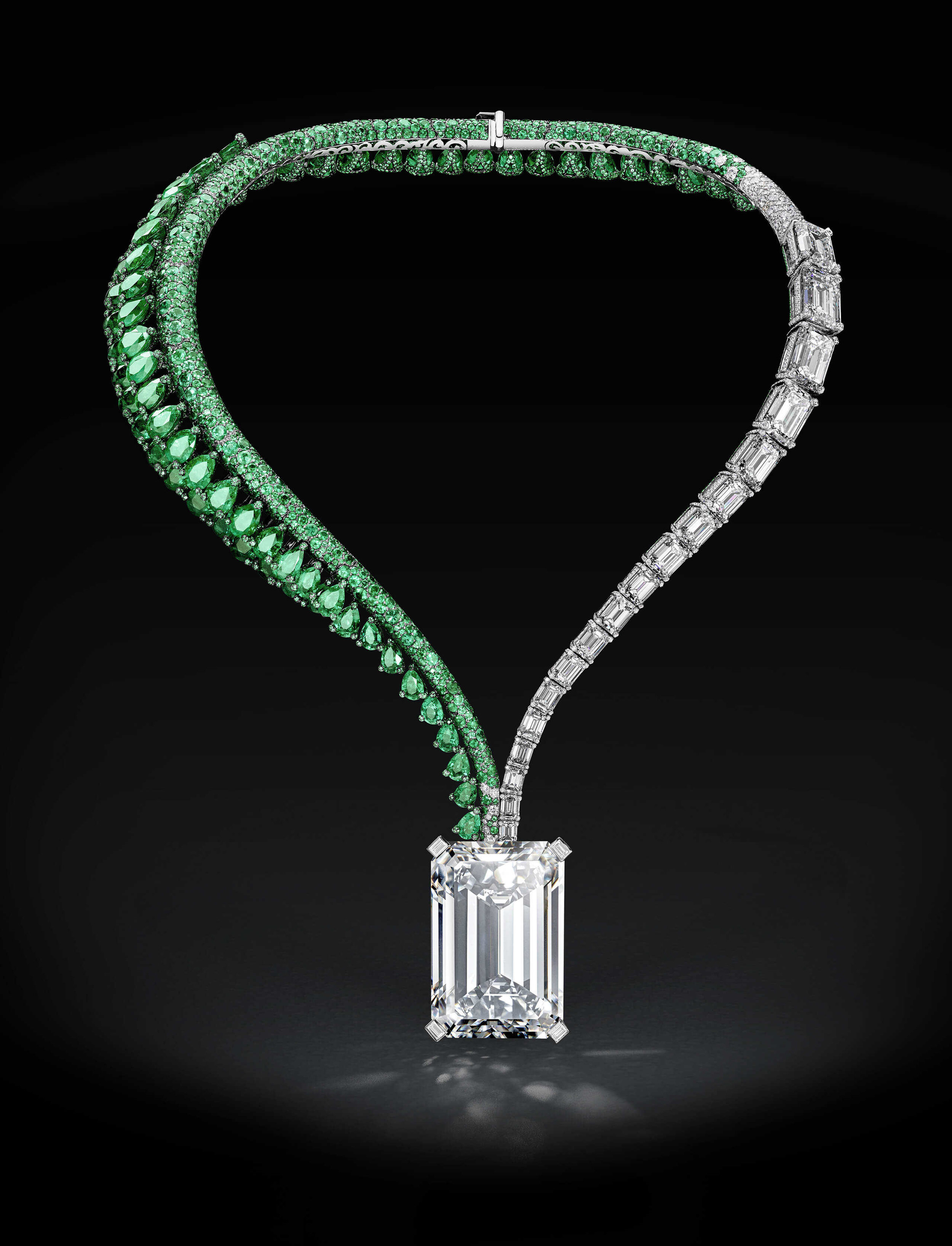
de GRISOGONO proudly presents an asymmetric necklace starring the 163.41-carat diamond as its centrepiece. The magnificent gem is framed to the left by 18 emerald-cut diamonds, and to the right by two rows of pear-shaped emeralds set against a darkened gold background creating the Maison’s signature chiaroscuro effect.


BLUE AND WHITE EWER YONGZHENG SEAL MARK AND PERIOD

This exceptionally rare and elegant ewer represents the height of early Qing porcelain production at the imperial kilns at Jingdezhen in Jiangxi province. Made during the reign of the Yongzheng emperor, it illustrates the emperor’s pursuit of innovative designs and forms as well as the replication of historical masterpieces as a reminder of the nation’s glorious past. Such developments were realized through the exceptional talent and creativity of potters working under the instruction of Tang Ying (1682-1756), the most accomplished superintendent at Jingdezhen during the early Qing period.
The distinctive form of this ewer is likely derived from European or Middle Eastern metalwork, although the model on which is was based is still to be identified. Whilst its intended purpose is also unknown, this form is known as huajiao or flower watering jug, although the shape is equally well suited to pouring wine. The form clearly found favor with the Yongzheng emperor, as a range of examples, both with and without handles, can be found in blue and white as well as with monochrome glazes.
Compare a closely related ewer of the same form and design in the Palace Museum, Beijing, illustrated in Gugong Bowuyuan cang. Qing dai yuyao ciqi [Porcelains from the Qing dynasty imperial kilns in the Palace Museum collection], vol. II, Beijing, 2005, pl. 44 (fig. 1); and two closely related handled ewers, also in the Beijing Palace Museum, the first with scattered floral sprays encircling the bulbous middle section of the neck, illustrated in The Complete Collection of Treasures of the Palace Museum. Blue and White Porcelain with Underglaze Red, vol. 3, Hong Kong, 2000, pl. 109; the other with a floret scroll band at the neck, illustrated in Gugong Bowuyuan cang. op. cit., pl. 43. Further related examples include one sold in our Hong Kong rooms, 26th October 1993, lot 169 and illustrated in Imperial Perfection. The Palace Porcelain of Three Chinese Emperors. A Selection from the Wang Xing Lou Collection, Hong Kong, 2004, pl. 8, and another, formerly in an English private collection, sold at Christie's London, 7th November 2006, lot 196.
For examples applied with a white glaze, see one formerly in the collections of Sir Harry Garner and Edward T. Chow, illustrated in Regina Krahl, Chinese Ceramics from the Meiyintang Collection, vol. II, London, 1994, pl. 794, and another in the Grandidier Collection in the Musée Guimet in Paris, illustrated in Oriental Ceramics. The World's Greatest Collections. Musée Guimet, vol. 7, Tokyo, 1982, pl. 170; and a third in the Palace Museum illustrated in Gugong Bowuyuan cang. op. cit. pl. 90.
A handled example applied with a flambé glaze, also in the Qing court collection, is illustrated in op. cit, pl. 143; another was sold in our Hong Kong rooms, 21st March 1979, lot 101. A ewer of this form but applied with a teadust glaze is illustrated in The Complete Collection of Treasures of the Palace Museum. Monochrome Porcelain, Hong Kong, 1999, pl. 244. A number of incised celadon-glazed ewers of similar form have been sold at auction, including one with a handle, sold in our Hong Kong rooms, 20th May 1980, lot 80; and one without a handle, sold in these rooms, 15th June 1983, lot 316, and later at Christie's Hong Kong, 28th November 2005, lot 1312.
Among the most distinctive features of this group of ewers are the bands of molded chrysanthemum petals encircling the lower body and shoulder. Porcelain wares inspired by the multi-layered petals of chrysanthemum flowers were a particular innovation of the Yongzheng period, as evidenced by a number of dishes, bowls and teapots in chrysanthemum form. In her article 'In the Path of Tao Qian: "Chrysanthemum" Wares of the Yongzheng Emperor', Arts of Asia, May-June 2015, pp 72-85, Hajni Elias expands on the symbolic associations of the chrysanthemum flower and the close associations with one of China's most famous poets, Tao Qian (365–427). Retiring from his official position in 405, during the tumultuous Six Dynasties period (222-589), Tao Qian spent a quiet life tending to his chrysanthemums and writing poetry. A painting formerly in the Qing court collection, and therefore likely treasured by the Yongzheng emperor, entitled Scholar of the Eastern Fence, by the early 13th century court artist Liang Kai (circa 1140-1210), shows Tao Qian in a landscape, holding a chrysanthemum flower in his hand. The Yongzheng emperor was a devout Daoist and the imagery of Tao Qian's decision to spend his life contemplating nature, and his direct association with the chrysanthemum flower, would have no doubt resonated with him and may have served as inspiration for commissioning the manufacture of chrysanthemum-form porcelain wares.