
Adrian Ghenie - THE SECOND PRESENTATION ROOM
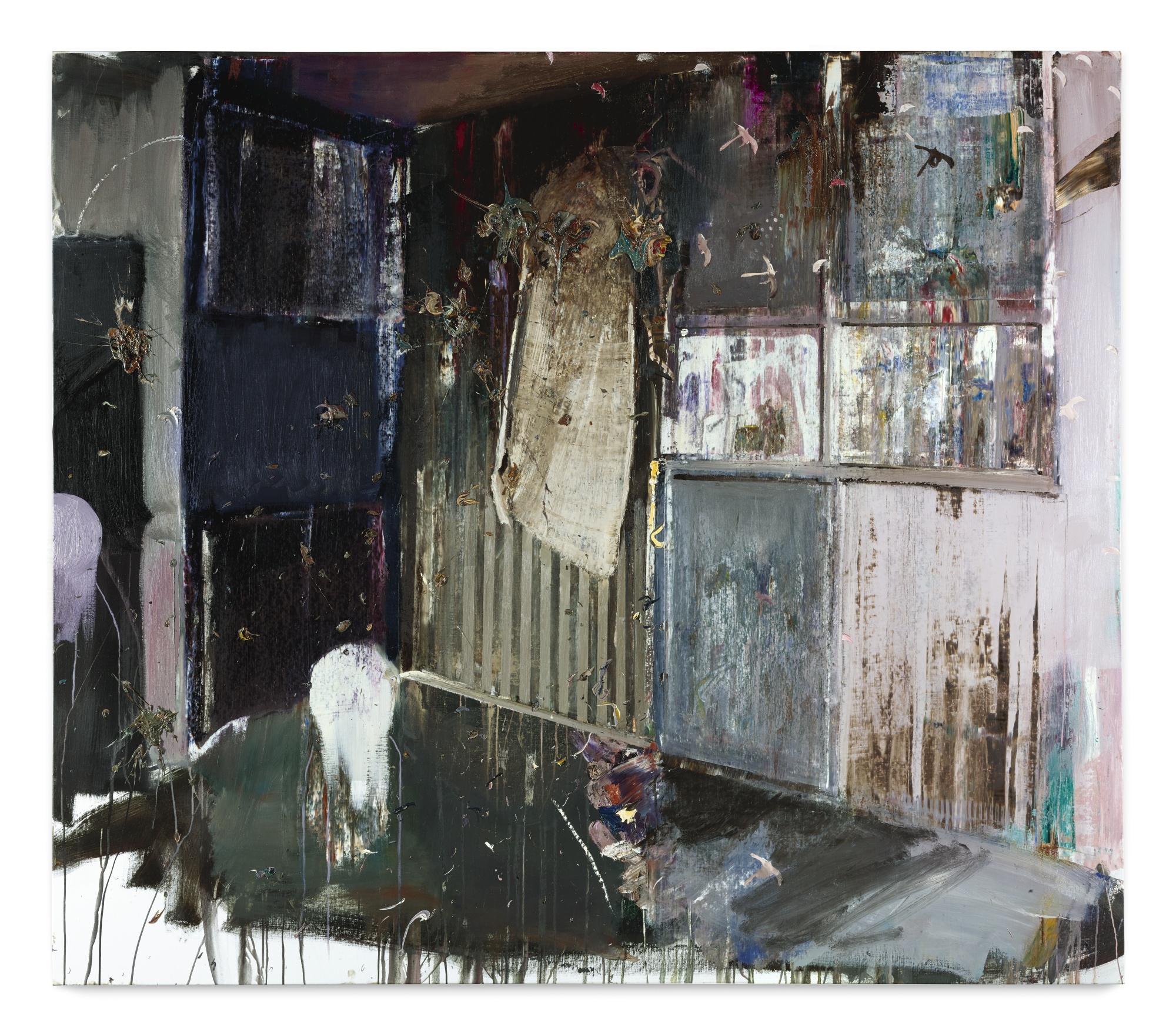
Inside Adrian Ghenie’s shadowed room, forces of brutality and beauty coexist. There is riveting painterly evidence of Ghenie’s physical assault on the canvas, where he has attacked the surface with loaded pigment using his palette knife to carve sensuous arenas of visual expression. On the richly textured surface, there are breathtaking accretions of color, startling chromatic contrasts, and textural flourishes rendered with extraordinary intensity. Drawing upon Baroque chiaroscuro, Ghenie's monumental 2011 painting The Second Presentation Room is cloaked in theatrical immanence and claustrophobia, heightened through the sumptuous passages of inky purple, dark olive green, and burnt crimson. A bold testament to Ghenie’s celebrated mastery of spatial composition, seductive textural quality, and compelling visual appropriation of allegorical historical references, The Second Presentation Room exposes the apotheosis of the artist’s creative genius.
The direct source employed by Ghenie for The Second Presentation Room is El Lissitzky’s Kabinett der Abstrakten, the Russian Constructivist's installation room conceived in 1928 for the Landesmuseum in Hannover. Lissitsky’s Abstract Cabinet represented the modular, organized theoretical framework of Constructivism, which called for a new form of art in the service of social revolution. As first espoused by Vladimir Tatlin in 1913, Constructivism rejected the autonomy of art and cultivated a method of thought that fused art and industrial functionality. Such fusion is clearly articulated by Lissitzky’s visually integrated presentation room, which emphasized the immaculate organization of space and the unadulterated purity of all art contained within that space. Appropriating Lissitzky’s iconic room, Adrian Ghenie interrogates the hopeful ideology of the fledgling socialist revolution. As Mark Gisbourne writes, “The pristine world of utopian constructivist ideas of clarity and definition have been despoiled and violated; a sort of Baroque ruination and set of surface accretions have taken their place. But it is intended less by the artist as a banal commentary on the lost utopian hopes of a revolutionary modernism, but rather on the claustrophobic nature and eventual material stasis that inevitably flow from preordained ideologies.” (Mark Gisbourne, “Baroque Decisions: the Inflected World of Adrian Ghenie” in Juerg Judin, Adrian Ghenie, Ostfildern, 2014, p. 28)
In Adrian Ghenie's childhood, Romania was ruled by Nicolae Ceaușescu’s tyrannical Communist regime; a period of severe political oppression and unrest that has significantly informed Ghenie's work. The Second Presentation Room discloses Ghenie’s personal history through aesthetic reference to his acute sensory memories from childhood, characterized by “the dirty and grubby surface textures of his father’s garage and cellar, his grandmother’s roof and garden, or his brother’s garage containing various detritus.” As Gisbourne observes, Ghenie first saw these spaces as “messy and untidy but texture-laden surroundings of shabby objects, broken furniture, rotting food and apples...yet they have come in retrospect to summarize in his mind a certain perception of his childhood.” (Ibid., p. 29) In the present work, Ghenie fuses aspects of his personal history with events from national history. Although he borrows from Lissitzky and from his private memories in order to interpret--or make sense of--the collective public history to which he belongs, in the end Ghenie constructs something far more powerful than the historical referent or his intimate personal consciousness. Ultimately, Ghenie conceives The Second Presentation Room on the basis of past realities, blending both ‘public’ and ‘private’ histories together, and then distorting these realities through the lens of his own fictive imagination. Conceived through Ghenie’s tactic of distortion, there is a palpable tension manifest in the present work between the real and the imaginative. Ghenie articulates this dichotomy through the oscillating spillages of representation and abstraction, fomenting a narrative that revises and even fabricates what we know to be real.
In the shifting perspectival planes of the present work, areas of recognizable imagery yield to swathes of pure abstraction. Deploying a wild gestural abandon through cyclical overpainting and excavation, Ghenie constructs a claustrophobic aura that underscores the metaphorical significance of the enclosed room. In the present work, the room not only functions as the physical setting, but a psychologically-inflected room of haunting human memory. Rather than alluding to a world beyond, The Second Presentation Room is a self-engendered entity, a cavernous emblem of the enveloped psyche. Vandalized, fragmented, and broken, the room capitulates and gives in to itself, subsiding and crashing into the picture plane like the collapsed ideology of a once-hopeful social revolution. It is this quality of self-effacement and visceral power, as rooted in both historical and personal reference, that renders The Second Presentation Room one of the most poignant works in Ghenie’s oeuvre to date.
McClean Design- Hillcrest





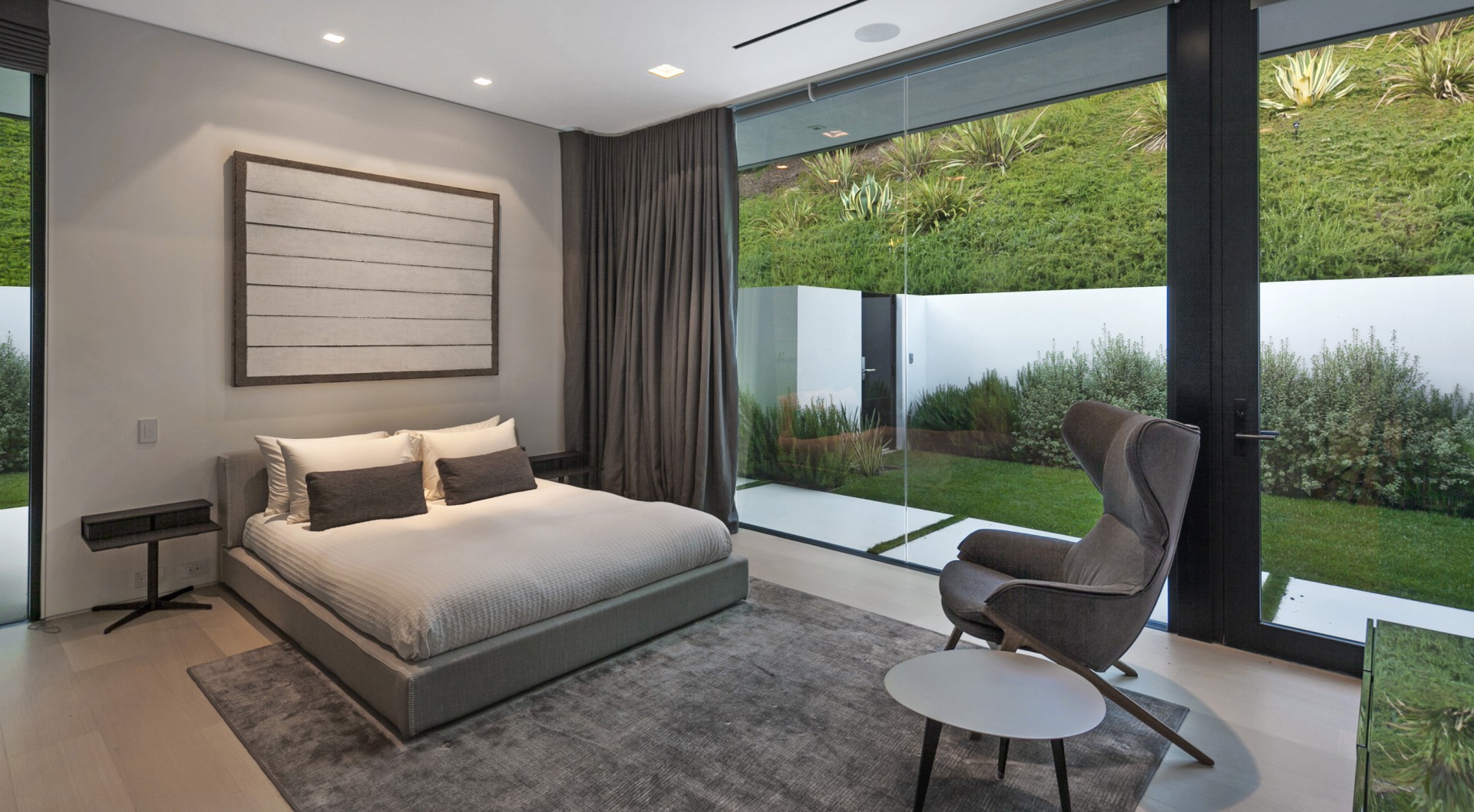


Hillcrest
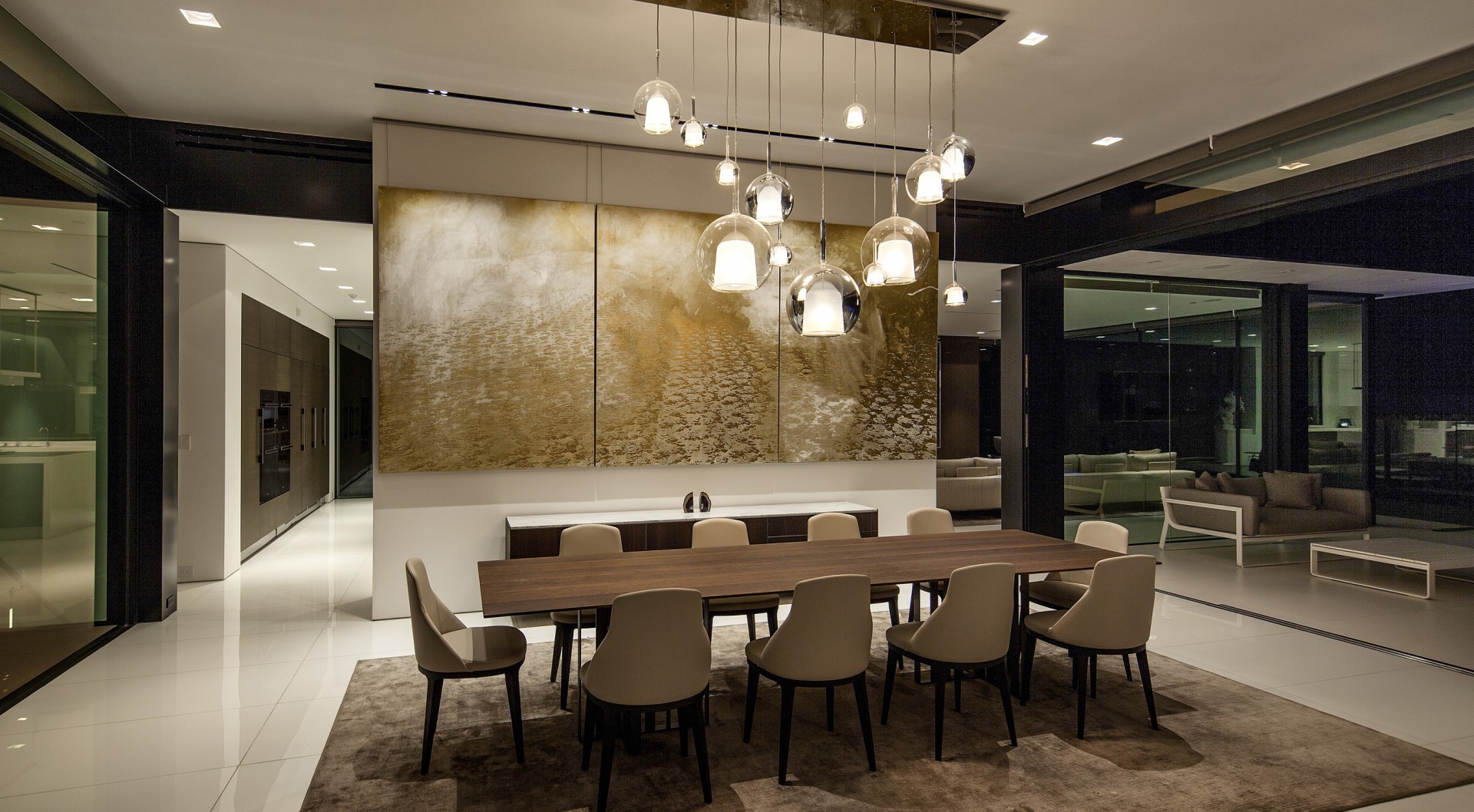
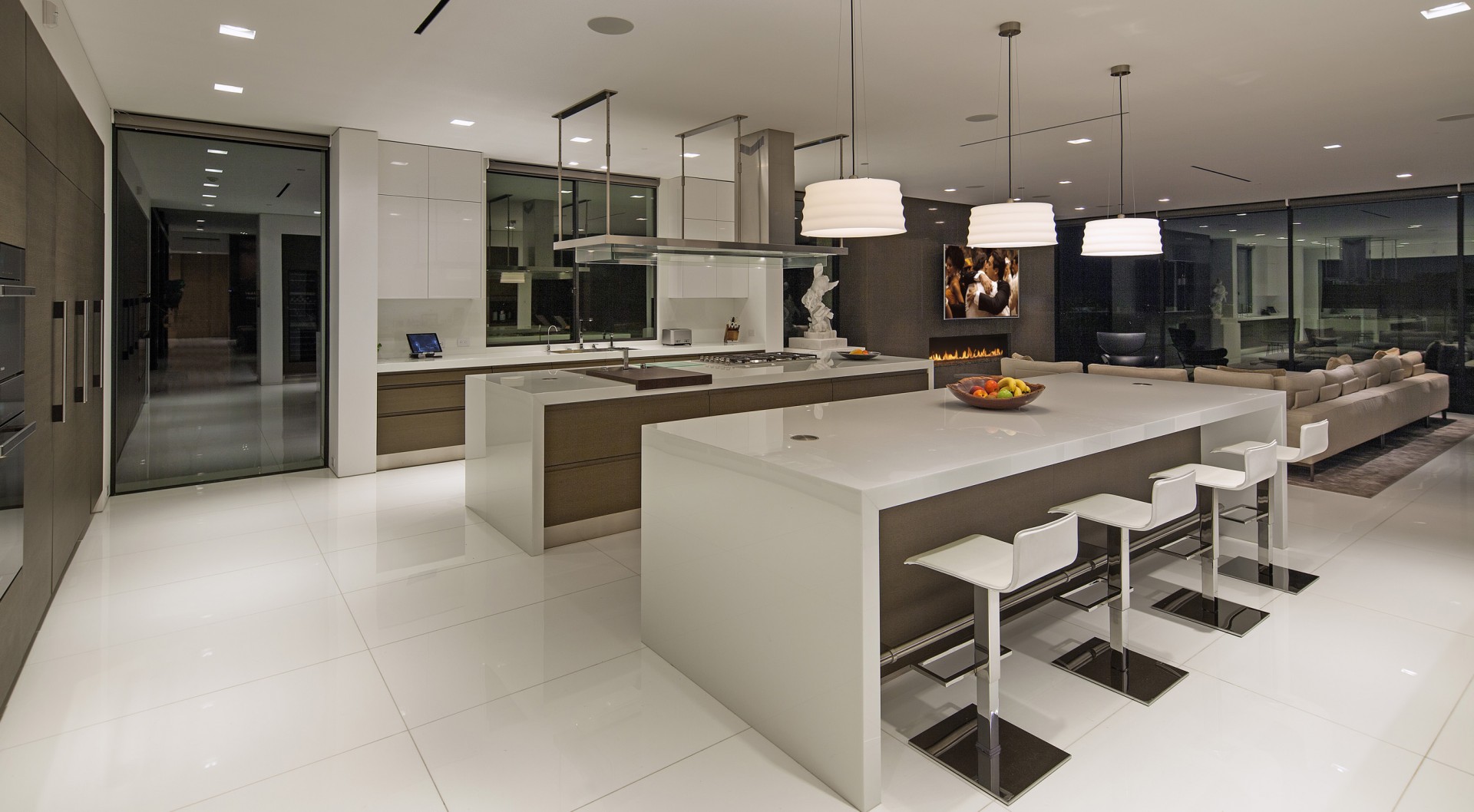
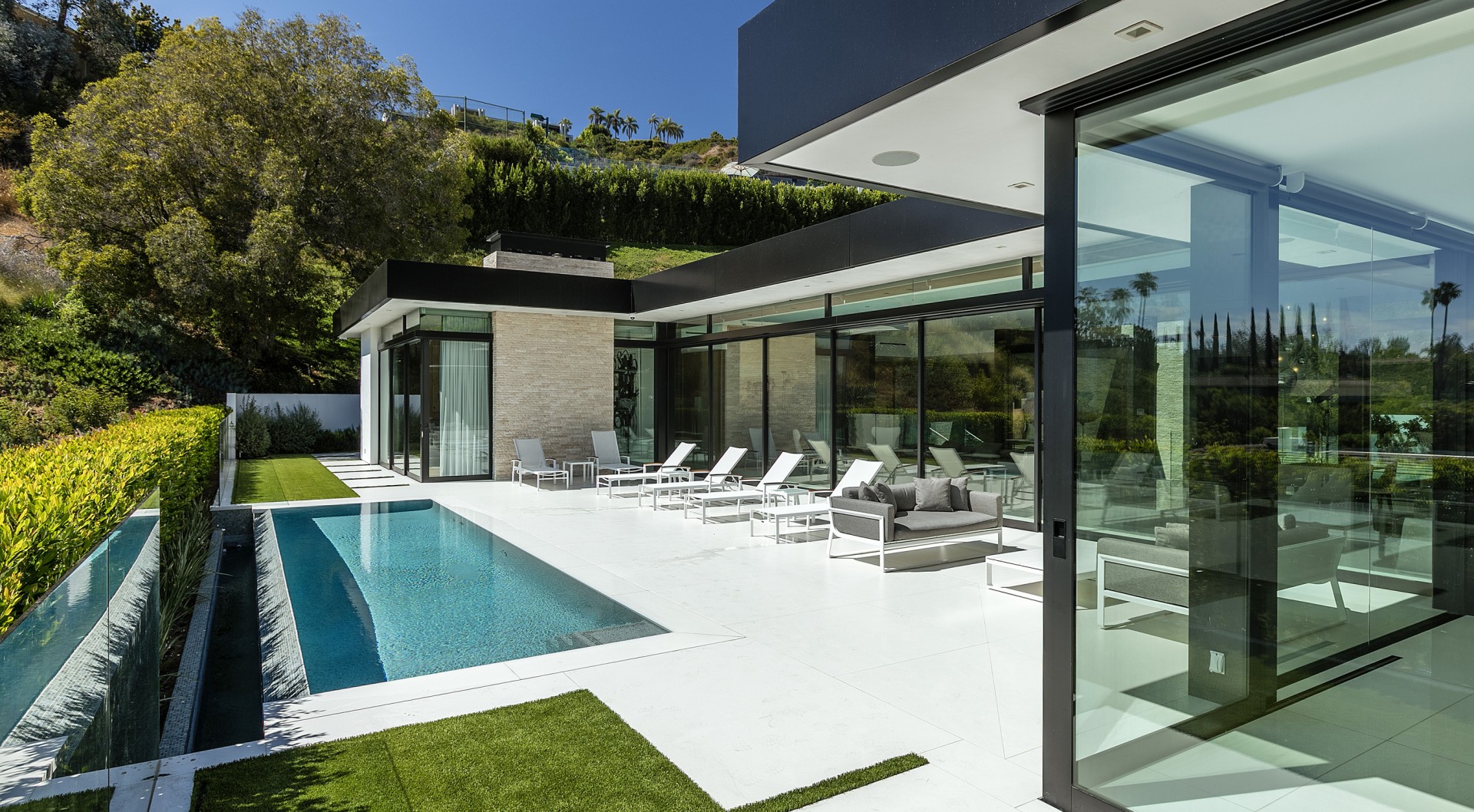
This hillside home is located in Trousdale, Beverly Hills a neighborhood of single story homes famed for their views and movie stars. Our clients wanted an extensive basement level to provide entertaining spaces due to the limited options above grade. Our challenge was to find a way to get light to these spaces since the design would need to consist of a true basement. We took the concept of a light well and expanded it to create a true water garden located in the middle of the house allowing us to create a dramatic glass bridge entry to the home. The bridge is a unique experience changing the user’s perception as they leave the garden behind and enter the house. The water garden below dapples light throughout the basement making these spaces amongst the most interesting within the house contrasting with the view orientated rooms above. The house is fused with natural light throughout and a warm palette of natural materials creates a very comfortable living environment.
Photographer: Jim Bartsch
LocationBeverly Hills, CA
Project TypeNew Single Family Residence
Approximate size 10,000 sf
Completion dated august 2016
Engineer Habib Soleymani
Jean-Michel Basquiat- SANTO 4

“The work Basquiat began in late 1982 signaled a new phase of intensity and complexity that focused on black subjects and social inequities and incorporates a growing vocabulary of popular images and characters…The effect was raw, askew, handmade—a primitive-looking object that recalled African shields, Polynesian navigation devices, Spanish devotional objects, and bones that have broken through the surface skin.” (Richard Marshall, “Repelling Ghosts,” in Exh. Cat., Malaga, Palacio Episcopal de Malaga, Jean-Michel Basquiat, 1996, p. 140)
Emblazoned with frenzied, gestural marks and urgent annotations that reflect the spontaneity of graffiti, Santo 4 is a significant milestone in the inauguration of Basquiat’s certified status as an international art star. It is universally acknowledged that 1982 was the most significant year in the artist's tragically short yet enduringly prolific career. Painted in this seminal moment and belonging to a small number of captivating works created on roughly hewn canvas supports, Santo 4 is a preeminent articulation of Basquiat’s expressionistic force, adept combination of cultural references and impactful iconography.
Created the year after Basquiat’s breakthrough participation in the now-legendary New York/New Wave exhibition at the P.S.1 Contemporary Art Centre, Santo 4 is the perfect encapsulation of the artist’s transition from street to studio. Whilst self-organized exhibitions such as the Lower Manhattan Drawing Show at the Mudd Club gave crucial exposure for the artist, his breakthrough participation in the P.S.1 show and success in the show Public Address at the Annina Nosei Gallery gave him the critical success that was to bring about a huge turning point in his career. Indeed, it was in this year that Nosei became Basquiat's primary dealer and staged a critically acclaimed solo show of the artist's work. Using Nosei's Prince Street gallery basement as his studio, Basquiat forged influential links with Bruno Bischofberger and Larry Gagosian. Subsequently, his rise to stardom was astoundingly accelerated: exhibited alongside Gerhard Richter, Joseph Beuys, and Cy Twombly he became the youngest artist to have ever participated in Documenta in Kassel, heralding 1982 as the definitive year in his sudden yet pervasive invasion of the art world. Looking back on this astonishing year, Basquiat recalled, "I made the best paintings ever." (Jean-Michel Basquiat cited in Richard Marshall and Jean-Louis Prat, Jean-Michel Basquiat, Paris 2000, p. 202)
Not only did 1982 bring about extraordinary critical success for Basquiat, it also saw the birth of a celebrated corpus of works stretched over jutting corner supports and exposed stretcher bars. Basquiat and his assistant at the time set about crafting stretchers and frames out of a whole host of found materials such as carpet tacks, rope, canvas and wooden mouldings. Insouciant and purposefully rudimentary, these structures physically dismantle and imbue the grand tradition of painting on canvas with the tribal and primitive, while also referencing a grander art historical tradition of assemblage and collage most influentially advanced in postwar American art by figures such as Robert Rauschenberg.
While the evocation of primitive art very much alludes to Basquiat’s ethnic heritage - born to Puerto Rican and Haitian parents and brought up in Brooklyn, Basquiat's art habitually draws on his triangular cultural inheritance – the artist was also intensely influenced by Picasso for whom primitivism was an antidote to the conservatism of the academies. Similarly, Basquiat finds in primitivism a correlative mode for expressing an overtly contemporary angst simultaneously tied to his own racial identity and his position as an artist responding to the cool minimalism that permeated the gallery scene in Manhattan during the early 1980s.
Dominated by a large skeletal figure surrounded by a medley of scribbled marks and scrawled annotations – emblematic of Basquiat's polemic urban iconography – Santo 4 is demonstrative of the very best of the artist’s celebrated practice. His use of the iconic skeleton motif is both formally and symbolically crucial. Whilst the skull acutely references modernist abstraction and Picasso’s engagement with African art, it also engages with Basquiat’s own identity as a black subject seeking expression within a seemingly ‘white-washed’ art world. As surmised by cultural theorist Dick Hebidge "… in the reduction of line into its strongest, most primary inscriptions, in that peeling of the skin back to the bone, Basquiat did us all a service by uncovering (and recapitulating) the history of his own construction as a black American male." (Dick Hebidge, ‘Welcome to the Terrordome: Jean-Michel Basquiat and the Dark Side of Hybridity’, in Exh. Cat., New York, Whitney Museum of American Art, Jean-Michel Basquiat, 1993, p. 65) Reduced to its skeletal framework the figure also purports Basquiat’s scientific interest in the anatomical makeup of human beings, a subject that had fascinated the artist from an early age. His mother gave him a copy of Grays Anatomy, when, after being hit by a car at the age of seven, he spent a month recovering in hospital. The anecdotal genesis of this interest was further substantiated when Basquiat discovered Leonardo da Vinci's pioneering studies of the human body. Furthermore, the rich assemblage of caricatured faces, arrows and scribbled phrases, which include a childlike sketch of an airplane in the left centre of the composition, recalls the urban iconography of the artist's SAMO days. Ubiquitous to the metropolitan environment of New York, crudely articulated images of cars and planes recur throughout his early work. Along with the words Tokyo, South Korea and Peking, the plane contributes to the global mood that pervades the present work and concurrently symbolises the artist’s growing international success.
Rife with Basquiat’s rich, multi-faceted iconography, Santo 4 imports a dense narrative steeped in symbolic potency. Belonging to Basquiat’s trailblazing group of stretcher paintings, it reflects the nascent global excitement surrounding the artist at the time and acts as a bold proclamation of his inauguration into art history. Rene Ricard, one of the artist’s most notorious critics, singled out this revolutionary body of work and proclaimed: “For a while it looked as if the very early stuff was primo, but no longer. He’s finally figured out a way to make a stretcher… that is so consistent with the imagery… they do look like signs, but signs for a product modern civilisation has no use for.” (Rene Ricard cited in Phoebe Hoban, Basquiat: A Quick Killing in Art, London 2008, p. 105)

2001 Bond Melbury
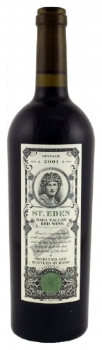
Bond is an Oakville, California, winery that makes widely acclaimed single-vineyard Cabernet Sauvignons based on an unusual business model. Founded in the late 1990s by H. William Harlan, who in 1984 founded Harlan Estate, Bond uses grapes from five vineyards that Harlan does not own. The winery refers to its offerings as “a portfolio of wines that are diverse in their geographic representation…” The name Bond was selected to highlight the “bond” between Harlan, his winemaking team, which includes his longtime associate Robert Levy, director of winegrowing, and the independent growers who supply the grapes. Each of the “grand crus,” as Harlan calls his Bond wines, has been given a proprietary name, such as Vecina and Melbury, meaning that although the goal is to make Cabernet Sauvignons using only single vineyard grapes, Bond reserves the right to blend if necessary. Besides the “grand crus” Bond makes Matriarch, a second wine. The vineyards Bond leases are 7 to 10 acres each.
Hôtel de Crillon

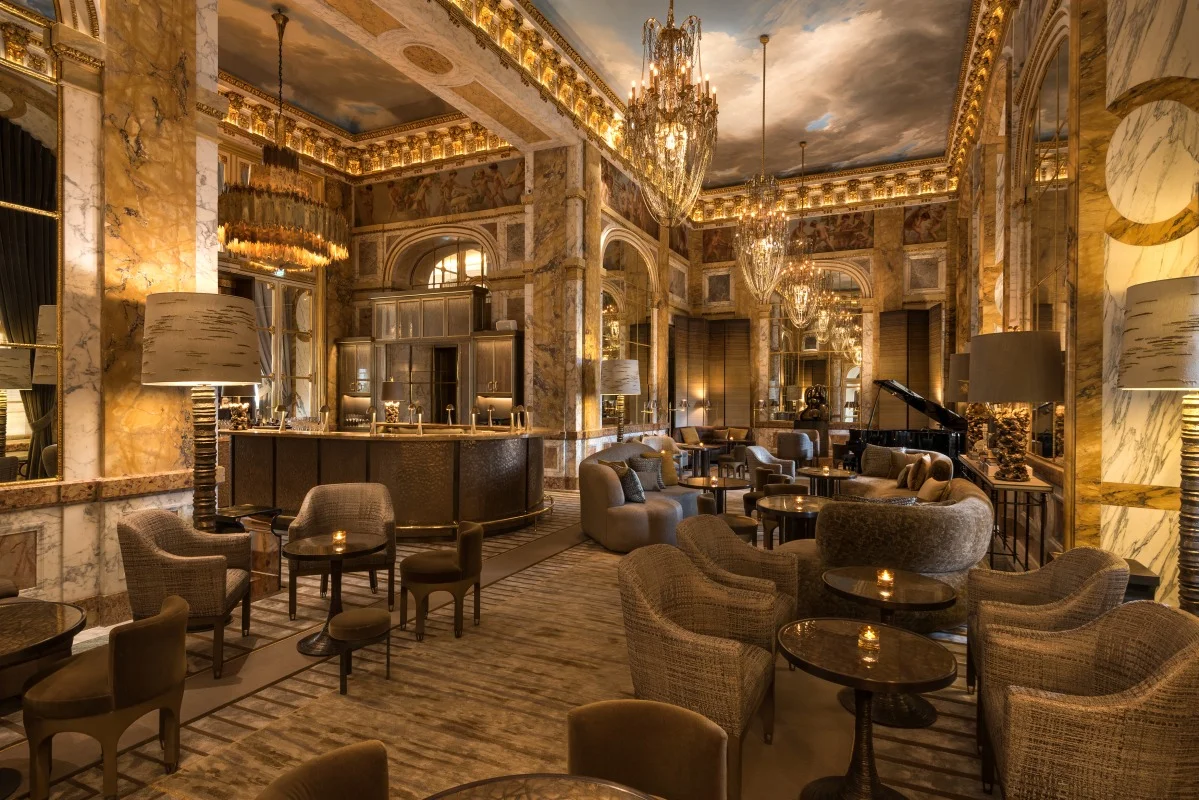


Reopening in 2017, Hôtel de Crillon, A Rosewood Hotel offers a delicate balance between conservation and transformation - a celebration of the spirit of Paris and French art de vivre. The legendary palace enjoys unrivalled position overlooking Place de la Concorde, minutes away from the city’s most iconic sites.
FLAMBE-GLAZED VASE QIANLONG SEAL MARK AND PERIOD

This rare vase is remarkable for its vibrant hues of ruby streaked with lavender, created in imitation of the celebrated Jun wares of the Song period. By the Qing dynasty, Jun wares were regarded as objects of admiration at court as well as amongst literati connoisseurs and wealthy merchant collectors. The Yongzheng and Qianlong emperors sought to reproduce the beautiful glaze effects and graceful forms of Jun wares by commissioning copies from the imperial workshops at Jingdezhen. The streaks characteristic of this glaze are known as yaobian (‘transmutation glaze’).
Vases of this type are rare and only a small number of related examples are known. Compare one, formerly in the collection of the Rt. Hon. Lord Hollenden, sold in our London rooms, 27th November 1973, lot 349. Another, acquired from Yamanaka & Co. Beijing, in 1919, was sold at Christie's London, 9th November 2010, lot 218.
Vases of this form are also recorded in other monochrome glazes, evocative of Song dynasty wares. Compare a number of Qianlong mark and period Ge-type vases, including one illustrated in Regina Krahl, Chinese Ceramics from the Meiyintang Collection, vol. 2, London, 1994, pl. 877; Compare a similar vase sold in our London rooms, 10th June 1986, lot 291, and again in our Hong Kong rooms, 20th May 1987, lot 519. A third example was first sold in our London rooms, 12th July 2006, lot 134, and again in the same rooms, 16th September 2009, lot 217.
J12 High Jewelry

Set with diamonds and brilliantly colored gemstones, these precious J12 variations feature sophisticated watchmaking expertise paired with the world of fine jewelry. An infinite expression of creativity by Chanel.
33 Strand Beach Drive


Once you step beyond the fully disappearing glass walls, to the ocean-facing terraces overlooking the surf and sand, you enter an environment of beach-front living to rival the best resorts in the world. With this home’s brilliant panorama of the blue Pacific and direct beach access, a more sublime surf-front oasis would be a challenge to discover. Art and artifacts, foliage and fossils - ancient and modern intersect to make this Balinese-style beach-front home arguably the most desirable property along The Strand. With more than 9,800 square feet of living space on three levels, the home grants seamless transition from indoor to outdoor spaces so ocean breezes can mix nonchalantly with heirlooms and architecture that enrich the home with a sense of understated sophistication and South Pacific ease. Renown architect Chris Light’s inventive approach to layout and design offer up a visual feast of inspiration and style starting curbside with its Jerusalem Limestone and Mahogany-trimmed exterior framing a secured courtyard entry with bronze “Buddha Hands” gate-pulls. The two-story foyer, with its mystical light fixture, unfolds to the main living areas and ocean-view office. The enchanting master suite, with dual bathrooms, opens to its private deck and panoramic ocean surf views – taking full advantage of the magnificent sunsets. Three additional bedroom suites and lounge are on the upper level. The lower level is an entertainment mecca – containing a wine area with 300-bottle display wall, movie area with full surround sound, fully-equipped bar, gym, sauna, steam shower, lounge seating area, powder room, and two outdoor living areas. The main-level open floor plan - blending dining, living, and entertaining areas - offers open access to the chef’s kitchen with its six-burner stove in front of a stunning blue onyx wall, separate full-sized refrigerator and freezer, double cooking islands, and is fully equipped with all imaginable amenities. Among the home’s distinctive features are mother of pearl tile walls, Limestone finishes, custom Mahogany trim and woodwork, Walnut plank flooring, woven bamboo ceilings, stainless steel beam accents, radiant heated floors, and Venetian plaster walls. Included in the outdoor space of this resort world are an infinity-edge swimming pool, spa, three fire pits, waterfall, direct beach access, beach shower, two outdoor lower-level lounge areas, and separate dog run and kids’ play area. Beyond the blend of organic elements lies a sophisticated backbone of integrated technology for convenient monitoring of the whole-house security, lighting, environment, and audio/visual systems of this exotic and refined ocean surf home.
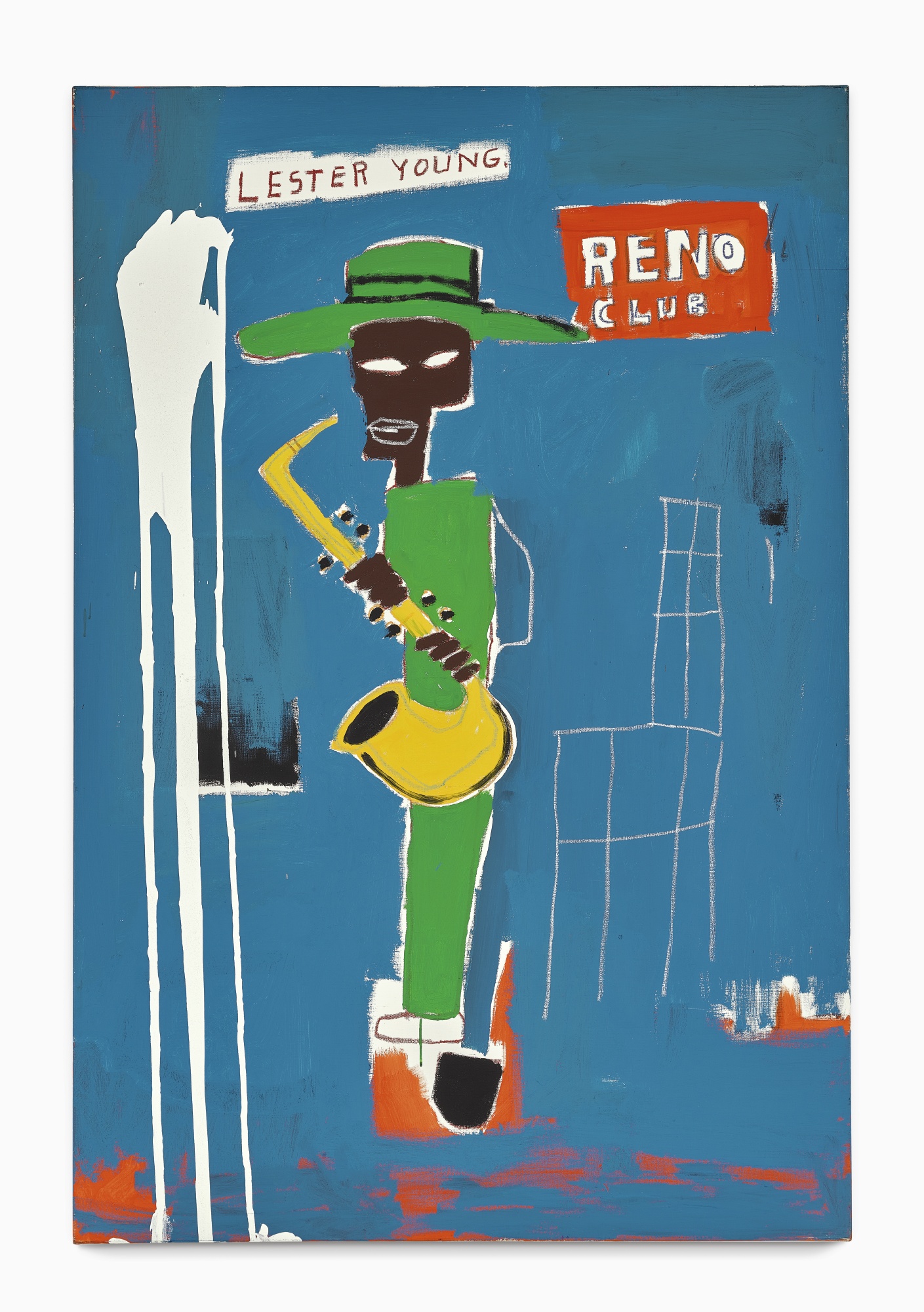
Jean-Michel Basquiat IN THE WINGS
“Jean-Michel began to incorporate the names of these songs and the linear notes of the records, and mesh those words with images in his painting…He immortalized those records in a way that blended with his style and was very much a part of where he was coming from. But always with a twist and sense of humor.” (Fred Braithwaite, “Jean-Michel as Told by Fred Braithwait a.k.a. Fab 5 Freddy, An interview by Ingrid Sischy,” in Exh. Cat., Malaga, Palacio Episcopal de Malaga, Jean-Michel Basquiat, 1996, p. 155)
Painted in the crucial moment of 1986, just two years before his untimely death, Jean Michel Basquiat’s In the Wings is undoubtedly one of the most charismatic cultural portraits of his entire oeuvre. Adding to the limited number of important paintings that he dedicated to the greatest jazz legends of the Twentieth Century, here Basquiat enshrines the image of Lester Young – arguably the most influential and innovative saxophonists of all time – and creates a highly personal, devotional icon for posterity. Beyond paying homage to his musical idol, Basquiat instigates a cross-generational synthesis of artistic volition as the fluidly improvisatory tones of Young’s radical jazz are given a perfect visual counterpart in the painter’s unique gestural flare. Bearing a relatively pared-down composition, an enigmatic blue background and by focusing on a single African-American figure, In the Wings is stylistically emblematic of the important set of works created in the final years of Basquiat’s career in which he focused more heavily on Black subjects. By inducting Lester Young into his great pantheon of Black cultural icons, Basquiat seeks to reshape narratives on African American culture, whilst simultaneously positioning himself as contributor to its great legacy. Having acknowledged himself as a relative rarity as a Black artist within a racially homogenous art world, through In the Wings Basquiat destabilizes the canon of cultural history by inserting Black consciousness at its forefront and chiefly positioning himself as its visionary narrator.
From famous athletes such as Sugar Ray Robinson, Cassius Clay, Tommie Smith and John Carlos, to political figures including Malcolm X and Marcus Garvey, Basquiat’s oeuvre is punctuated by emphatic references to ground-breaking African American figures of the 20thcentury. Reverentially valorizing their successes in the face of staunch adversity and extreme racial prejudice, the historic development of American jazz music became Basquiat’s third arena in which to explore the rich and influential products of Black culture. Such as in the 1983 work Horn Players, now in the collection of the Broad Museum in Los Angeles, from early in his career Basquiat celebrated what Bell Hooks has described as "the innovative power of black male jazz musicians, whom he reveres as creative father figures," later proceeding to depict significant musicians such as Charlie Parker, Dizzie Gillespie, Ben Webster, Duke Ellington, Max Roach, Billie Holliday and Lester Young. (Bell Hooks, 'Altars of Sacrifice: Re-membering Basquiat' in Outlaw Culture: Resisting Representations, New York, 1994, p. 35) Painted in the same year and bearing the same blue backdrop as the present work, King Zulu (Barcelona Museum of Contemporary Art) is another work also dedicated to a founding feather of American Jazz, Louis Armstrong.
From the 1950s, as a predominately African American Art form, Be-bop Jazz revolutionized the trajectory of music by privileging a highly expressive and improvised approach that finds a replete parallel in Basquiat’s painterly freedom. With individualism and experimentation at the heart of jazz music, each of Basquiat’s jazz heroes maintained a distinctive vocal or musical style, making unique artistic contributions to the development of the genre. Starting as an innovative member of Count Basie's band in Kansas City in the mid 1930s, Lester Young is one such figure who redefined jazz through his sensual refinement of Swing music. In the present work, Basquiat ultimately mirrors the relaxed tone and sophisticated harmonies that set Young’s music apart from his contemporaries in the supreme formal balance that also retains a sense of energetic improvisation. Compared to the densely frenetic compositions of the early 1980s, here we see a wise and confident Basquiat carefully selecting references and techniques – marrying style and content – to offer a highly particular vignette.
Young was well known for the unorthodox manner in which he positioned his saxophone as he played. Emerging from a brilliant blue backdrop, Basquiat privileges this detail with the contrasting yellow glare of the centralized instrument. Grasped by the dandyishly styled Young in a vibrant green suit and wide-brimmed hat, the charismatic musician is spot-lit and center stage in the composition. Surrounded by the stupefying abstract rhythms of the artist’s brush, a visceral cascade of gestural white paint down the left edge of the picture provides a synesthetic evocation of free flowing sound. Yet, whilst the canvas chimes with the exuberance of a live performance, Basquiat’s use of text and his characteristic insistence on two-dimensional depiction seems to intimate a promotional poster or perhaps a record cover, as his immediate frame of reference. Having died in 1959, Basquiat’s evocation of the “Reno Club” refers to an original live recording made there in Kansas city in 1936; one of the many Jazz records that provided an inspirational score against which his distinct subjective visions were created. Basquiat’s expedient rise to success had come through his fresh presentation of a diverse mélange of cultural influences, from graffiti tags to comic books and even food packaging. Here he simplified his unique symbolic lexicon to focus on one favored moment in the history of jazz.
Whilst Lester Young was known for having popularized much of the jazz ‘hipster jargon’ associated with the genre, here Basquiat evades his own characteristically ambiguous use of words, privileging instead their ability to designate the specific moment. This open stage allows Basquiat to bathe his central icon in a fittingly lyrical abstraction that shows the full range of his transcendent technique as both a painter and draughtsman. As Robert Farris Thompson describes, Basquiat consciously enters into a nuanced dialogue with his painterly predecessors: "Basquiat himself did not parody Abstract Expressionism, as Pop Masters sometimes did. As he fused his sources, his mood was more complex: humour, play, mastery, and stylistic companionship. He brought into being first-generation (Kline) and second-generation (Twombly) Abstract Expressionist citations and mixed them up amiably with cartoon, graffitero, and other styles." (Robert Farris Thompson, 'Royalty, Heroism, and the Streets: The Art of Jean-Michel Basquiat' in Exh. Cat., New York, Whitney Museum of American Art, Jean-Michel Basquiat, 1992, p. 36) Whilst the luscious drips of free-flung white provide a nod to Jackson Pollock, the whimsically minimalist scrawl of the white squares that suggest a chair seem to toy with the authority of the minimalist grid, promulgated by Sol LeWitt, Donald Judd and Agnes Martin. Invigorating the background with a static red that demarcates form and bleeds through in the manner of both Robert Motherwell and Clyfford Still, Basquiat usurps the authoritarian schools of painting that dominated American art until his arrival upon the New York scene, whilst responding to the revolutionary aural experience of Young’s music.
Crucially, Basquiat’s highly abstracted treatment of Young’s face brings to light the intersection of race, representation and culture that underscore the painting. Composed of a rich mahogany brown, the highly stylized eyes and naively emphasized lips take a dually provocative role by recalling both the resounding influence of African art on modern masters such as Picasso, as well as the unsettling aesthetics of minstrelsy and the archaic racial stereotypes that once permeated American visual culture. As surmised by cultural theorist Dick Hebidge "… in the reduction of line into its strongest, most primary inscriptions, in that peeling of the skin back to the bone, Basquiat did us all a service by uncovering (and recapitulating) the history of his own construction as a black American male." (Dick Hebidge, "Welcome to the Terrordome: Jean-Michel Basquiat and the Dark Side of Hybridity," in Exh. Cat., New York, Whitney Museum of American Art, Jean-Michel Basquiat, 1993, p. 65) In his tribute to Lester Young, on one level Basquiat gives aesthetic form to the revolutionary rhythms of jazz as a means of celebrating the legacy of Black culture and the historic achievements of Black artists. However, in also considering African American identity at the intersection of personal experience and a set of performative masks, he has immortalized his own subjectivity within the canon of cultural consciousness.
McClean Design- Sunset Strip





Sunset Strip
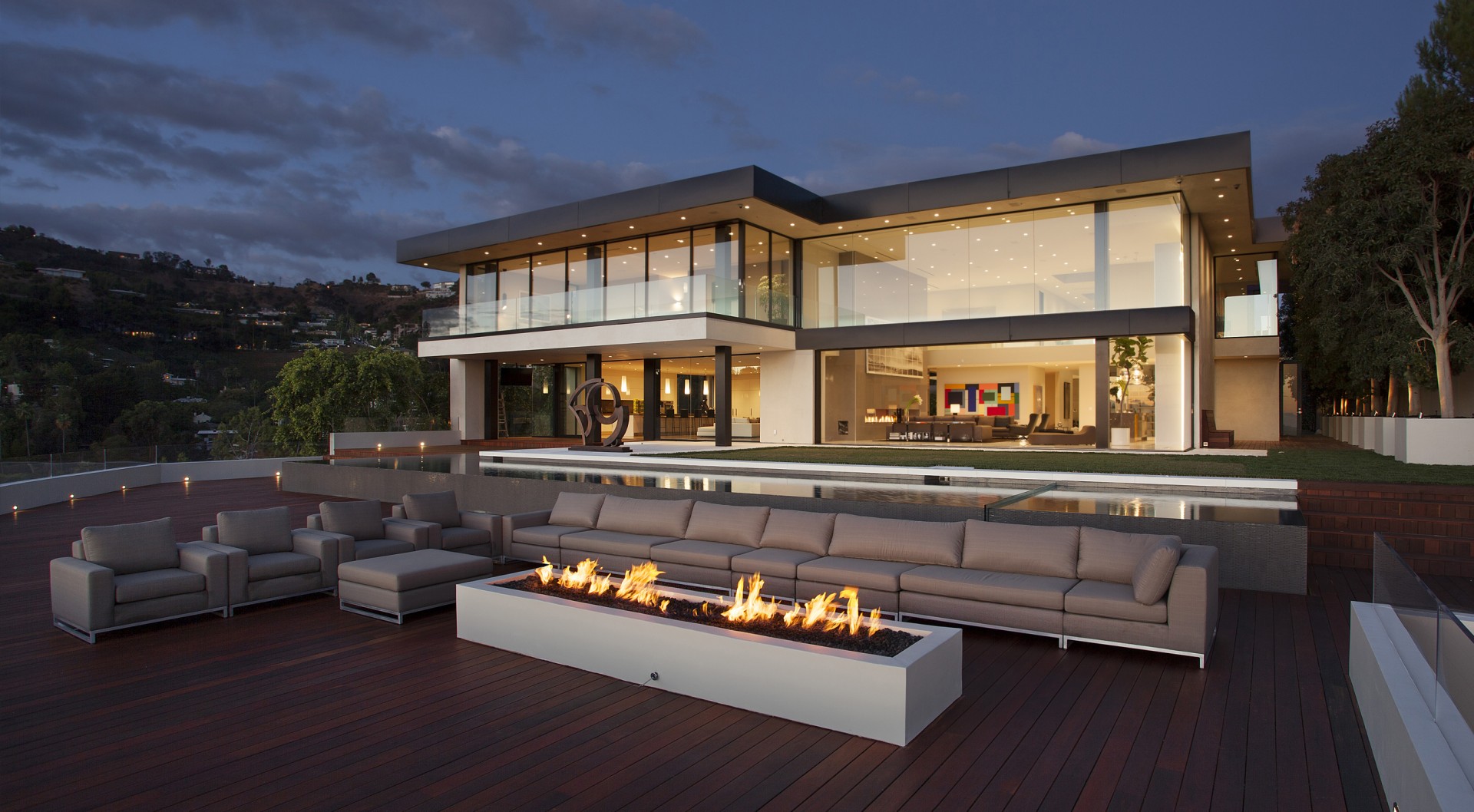
The house is approached by means of a gated driveway and guard house. Passing through the gate a landscaped hedge leads to the drive court which is centrally located between the house, garage, and guest house. The garage sits in a spot that enjoys spectacular views of the surrounding canyons so we designed it to be glazed on both sides. All three buildings are connected by a water feature that leads the eye to a pool and spa at both ends. The main house is approached along the water feature by means of a short stair which leads to the front hallway, glazed and open on three sides with room for a significant art piece on the focal wall. The entry leads to a stairwell where a beautiful chrome and stone stair ascends to the upper level bedrooms. Directly ahead is the living room, doors open to the right where the dining room is located overlooking the water feature. To the rear, tall suede door lead to the library/ informal media room where pocketing doors access a private landscaped garden. An interesting feature of this room is that the same film is projected on both sides of the drop down screen allowing people to circle around and watch from both inside and out.
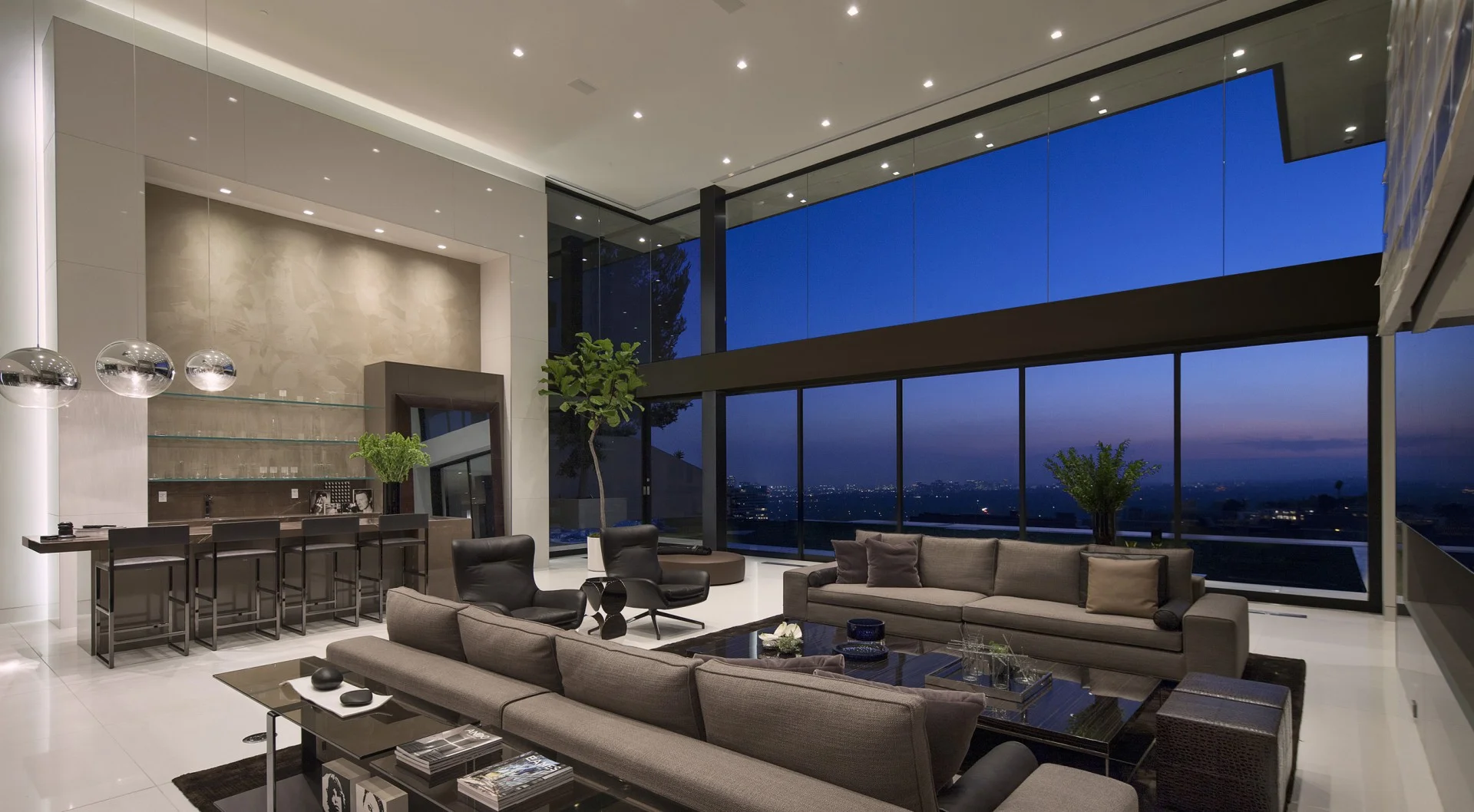
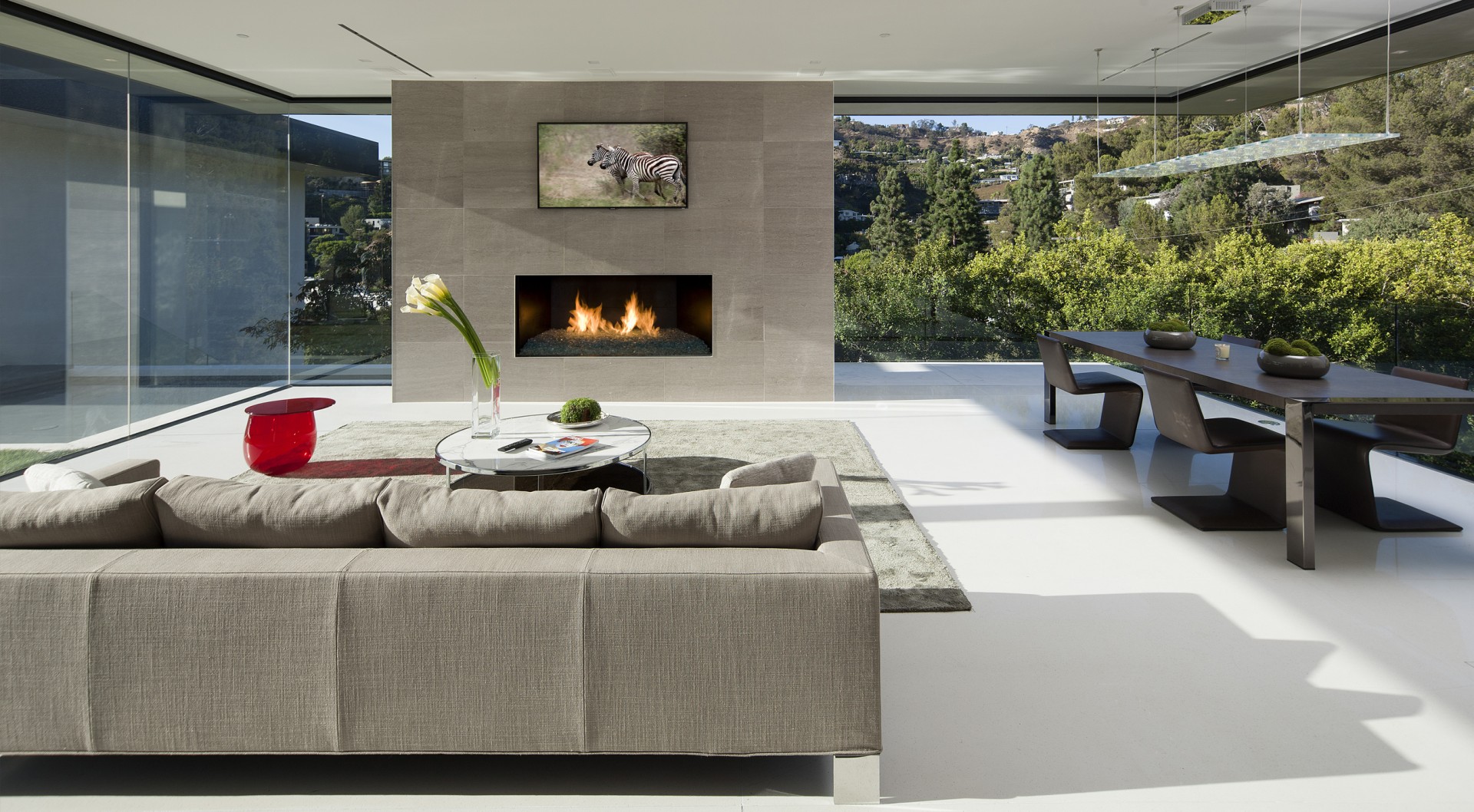
The main living room is two stories tall and enjoys spectacular views of the Los Angeles Basin and the ocean beyond. The room incorporates a bar and glazed wine cellar as well as an elongated see through fire place that is visible from the family room on the other side. The combined kitchen and family room has a more intimate feeling than the living room and appears to float over the water feature. From here it is possible to look back along the water past the garage all the way to the guest house and beyond. This room also enjoys wonderful views of the city below and leads directly to the back yard, covered dining area and expansive elevated terrace below the infinity pool. This terrace is designed for entertaining large groups and incorporates an extended fire feature and comfortable seating. This level of the house is completed by services spaces and an office for the owner.
Below the main level are two large bedroom suites each with their own outdoor area. Across the lower courtyard is the gym and wellness center. Located directly below the garage it incorporates sliding walls of glass to make the most of the mild climate. The upper level of the house contains the master as well as two additional bedrooms. At the top of the stairs there is a gallery space that looks into the living room below and out to the water feature. The master bedroom itself has his and her bathrooms complete with large closet areas. The sliding panels of glass surrounding the bed and sitting area open automatically to the deck which reveals the best view of the house enjoyed by this room. The other two bedrooms are expansive and have their own walk in closets and separate baths.
Across the drive court from the main house a separate and independent guest house contains two bedrooms, living, dining and kitchen and its own services spaces. The palette of materials is designed to be warm and contemporary. We have made extensive use of polished stone and added wood elements for warmth. All kitchens and bathrooms in corporate Italian furniture and fixtures, windows and doors are bronzed aluminum. The house is located in one of Los Angeles most famed neighborhoods, only minutes from Sunset Strip yet still enjoying a piece and serenity made possible by the surrounding nature.