The Pink Star: One Of The World's Great Natural Treasures
553,037,500HKD

Meticulously cut by Steinmetz Diamonds over a period of nearly two years - a process in which the 132.50 carat rough was cast in epoxy more than 50 times in order to create models upon which the design team could experiment with different cuts -it was transformed into this spectacular 59.60 carat, fancy vivid pink, internally flawless oval cut gem – the largest internally flawless or flawless, fancy vivid pink diamond that the Gemological Institute of America (GIA) has ever graded.
The diamond was first unveiled to the public in May 2003 as the ‘Steinmetz Pink’, and was modelled by Helena Christensen at a dedicated event thrown to coincide with the Monaco Grand Prix. Writing in the Financial Times on the 31 May 2003, Mike Duff described the diamond as “the rarest, finest, most precious stone the world has ever seen”. The stone was first sold in 2007 and was subsequently renamed “The Pink Star”. In the same article, Tom Moses, Executive Vice President and Chief Laboratory and Research Officer of the GIA, is quoted as saying: “it’s our experience that large polished pink diamonds – over ten carats – very rarely occur with an intense colour… The GIA Laboratory has been issuing grading reports for 50 years and this is the largest pink diamond with this depth of colour [vivid pink] that we have ever characterised”.
Of all fancy coloured pink diamonds, those graded ‘Fancy Vivid’ are the most precious and desirable. The current world auction record for a pink diamond is the Graff Pink, a superb 24.78 carat diamond which sold at Sotheby's Geneva in November 2010 for US$46.16 million. Weighing in at 59.60 carats and graded as Fancy Vivid, the Pink Star is twice the size.
In the summer of 2003, this amazing gem was exhibited at 'The Splendor of Diamonds' exhibition at the Smithsonian National Museum of Natural History in Washington, DC. Displayed in the Winston Gallery alongside the 45.52 carat blue Hope Diamond, the exhibition featured seven of the world’s rarest and most extraordinary diamonds. Also on view for the first time in the United States was the 203.04 carat De Beers Millennium Star, one of the largest diamonds in the world; the Heart of Eternity blue diamond; the Moussaieff Red, the largest known red diamond in the world; the Harry Winston Pumpkin Diamond; the Allnatt, one of the world’s largest yellow diamonds at 101.29 carats; and the Ocean Dream, the world’s largest naturally occurring blue-green diamond.
Commenting at the opening of the exhibition, Dr. Jeffrey Post, curator of the Gems and Minerals Collection of the Smithsonian National Museum of Natural History said, “Each of the diamonds is the finest of its kind and together with the museum’s gem collection makes for an exhibit of truly historic proportions”. In the three months the exhibition ran, the Smithsonian Museum of Natural History attracted more than 1.6 million visitors.
From July through November 2005, The Pink Star again took centre stage, this time at the 'Diamonds' exhibition held at the Natural History Museum, in London. “This exhibition will bring together many of the most impressive single stones in the world, fascinating science, and insights into the diamond industry to tell the story of diamonds from deep in the Earth to the red carpet,” said Michael Dixon, director of the Natural History Museum. For five months, the dazzling exhibition attracted approximately 70,000 visitors a day.
Jean-Michel Basquiat "ANTAR"

“He reproduces on the canvas the abstract figural power of his experience, the declarative and narrative temperament, the explicit and didactic strength, the confused condition and the spontaneous aggression of visual elements.” (Achille Bonito Oliva in Exh. Cat., Naples, Castel Nuovo, Basquiat in Naples, 1999, p. 25)
In its dominating scale, compositional intensity, expressionistic force, and deft engagement with art history, politics and race, Antar is demonstrative of the very best of Jean-Michel Basquiat’s celebrated practice. Masterfully distilling the quintessence of socio-cultural concerns and vibrant stylistic techniques, Antar utterly characterizes his works of the mid-1980s. The present work calls forth elaborate iconographies from ancient cultures, with primitive sculptures, masks and a canoeing tribal figure encircling a savage mythical creature, wielding a bloodied spear. Referencing the mythical figure of Antar, the pre-Islamic Arabian knight and poet whose legacy as a warrior and intellectual is recounted throughout Arabic literature and visual arts, Basquiat draws on a host of pre-historic references to paint an expansive canvas rich in symbolic imagery and allegorical content. Via an astounding pluralistic command of art historical vernacular that synthesizes graffiti, primitivism and Abstract Expressionism, Basquiat presents a powerful racial dialectic as a palimpsest of post-modernity. Indeed, such intense erudition is authoritatively delivered by an unsurpassed magnificence of surface manipulation. Streaming drips of acrylic and viscous clumps of oil stick lyrically coalesce to create an exuberant and formally stunning masterwork that posits Antar among the most painterly of Basquiat's entire production.
Antar was created at a moment when Basquiat had reached an absolute pinnacle of celebrity and recognition, following his rapid rise to artistic prominence in 1981 when his works were first exhibited in public. Born into a regular working family in Brooklyn, New York, at the age of seventeen Basquiat dropped out of school and moved to Manhattan’s spirited Lower East Side. With few resources other than sheer determination, within just four years the young artist progressed from intermittent bouts of homelessness and the ubiquitous dissemination of his ‘SAMO’ graffiti tag across the city, to being introduced to an enamoured art world as ‘The Radiant Child’ through René Ricard’s seminal Artforum article of December 1981. Represented in 1985 by two of the leading gallery owners of the day, Bruno Bischofberger and Mary Boone, Basquiat’s paintings attracted almost hysterical acclaim when exhibited, and seemed to epitomise the cultural zeitgeist of 1980s New York, a city unabashedly dominated by conspicuous consumption. Basquiat’s dominance and conquest of the New York art world was reinforced by his presence on the cover of ‘The New York Times Magazine’ on February 10 1985, accompanied by an effusive article written by Cathleen McGuigan. McGuigan declared: “The extent of Basquiat’s success would no doubt be impossible for an artist of lesser gifts. Not only does he possess a bold sense of colour and composition, but… he maintains a fine balance between seemingly contradictory forces: control and spontaneity, menace and wit…” (Cathleen McGuigan cited in Exh. Cat., New York, Whitney Museum of American Art, Jean-Michel Basquiat, p. 246) McGuigan’s reference to ‘menace and wit’ appears particularly apposite in the case of Antar, in which the seemingly threatening nature of the facial expressions of the red eyed mask and ferocious mythical beast are brilliantly countermanded by the element of humor conveyed by the floating canoeing man whose face is plastered with an unerring grin.
In many ways, Basquiat’s extraordinary reinterpretation of figuration represents a critical retort to the intellectualized currents of Minimalism that permeated the Manhattan gallery scene during the early 1980s. Basquiat explained in 1985: “The art was mostly minimal when I came up and it sort of confused me a little bit. I thought it divided people a little bit. I thought it alienated most people from art.” (Jean-Michel Basquiat cited in Exh. Cat., Basel, Fondation Beyeler, Jean-Michel Basquiat, 2010, p. XXIII) Basquiat forged an aesthetic that combined a Pop integration of comic book imagery with gestural abstract passages very much attuned to a contemporaneously outmoded high-art language of Abstract Expressionism. Possessing a sophisticated knowledge of art history Basquiat infused his painting with a defined instinctual understanding of the language of abstraction. In the present work forceful painterly strokes are deployed with an assured command, over which layers of erased, painted over and liberally confident mark making recast an innovative symphony of abstract expressionism’s pictorial vernacular. Basquiat commands, combines and synthesizes these paradigms of American art with spectacular faculty: the schematic background, great swathes of deep blue, red and green are laid down with intense, gestural brushwork. The artist's brute force of application and layering of paint and line through brush and oil stick confers a remarkably paroxysmal yet deliberate harmony via a structural and exuberant formalism. There is no spatial recession or perspectival logic to the composition; form and ground mesh together to confer an implosion of form to pure energy. Imbued with the frantic exertion and the poured, dripping aesthetic of Jackson Pollock; combined with the exuberant colorism and dramatic painterly gesture of Willem de Kooning and Franz Kline, Basquiat's grasp and deployment of Twentieth Century American art history is impressive and manifold. With the present work, Basquiat deftly weaves the machismo painterly attitude of Kline in the expansive and expressive gestural blue background with ethereal Twombly-like ciphers of line.
Of Puerto Rican and Haitian descent, and raised in Brooklyn, Basquiat drew from his manifold ancestral background and racial identity to forge a body of work acutely conscious of his contribution to the meta-narrative of an almost exclusively white Western art history. Basquiat aligned himself stylistically with Picasso, for whom primitivism was an antidote to the conservatism of the academies. Painterly elements extrapolated from the early Twentieth-Century master’s canon of abstraction and treatment of line thread a course throughout his oeuvre. Spanning Picasso’s Cubist undoing of the figure, through to the ground-breaking African Period, Basquiat masterfully quotes and re-appropriates. In the present work, such a reading is certainly at stake within the twisting application of line and stuttering dynamism of its composition, whilst, the mask-like figure undoubtedly evokes the kind of tribal masks apparent in Picasso’s masterwork, Les Demoiselles d’Avignon (1907) and his abstracted Self Portrait (1906). Basquiat found in primitivism a correlative mode for expressing an overtly contemporary angst tied to his own black identity, embodying his projected “blackness,” while subverting these very identity constructions by emulating Western conventions of painting.
Sophisticated, confident and radiating a conviction of artistic vision, the extraordinary visual power of Antar is a sheer testament to the thriving talent of a young and brilliant artistic spirit who, by 1985, had truly secured his position at the vanguard of an artistic consciousness. The present work solidified Basquiat as a figure who dashed effortlessly between art historical precedents in order to create a wholly individual painting deeply suffused with personal history, memory and emotion.
Bugatti- Chiron




The Chiron1 is the most modern interpretation of Bugatti’s brand DNA and embodies our new design language. The styling accentuates the performance aspect of the super sports car. The motto adopted by the Bugatti designers for the Chiron was “Form follows Performance”. Inspired through Bugatti Type 57SC Atlantic the new design language is characterised by extremely generous surfaces, which are demarcated by pronounced lines in the case of the Chiron. Thereby most of these elements have a technical background and have been designed to fully accentuate the growing performance requirements of the Chiron.
Oyster Perpetual Sky-Dweller


An elegant watch for world travelers, the Oyster Perpetual Sky-Dweller is a compelling timepiece of revolutionary design that blends to perfection technological sophistication and ease of use. A technological masterpiece protected by 11 patents, the Sky-Dweller provides, in an unprecedented and highly original way, the information global travelers need to easily keep track of time. It includes a dual time zone, with local time, read via centre hands and a reference time display in a 24-hour format read via a rotating off-centre disc on the dial; a particularly innovative annual calendar named Saros – after the astronomical phenomenon of the same name – that requires only one date adjustment a year, when the month changes from February to March; and a month display by means of 12 apertures around the circumference of the dial. To set its functions quickly and easily, the Sky-Dweller is also equipped with an innovative patented interface: the rotatable Ring Command bezel.
The Grand Hibernian







The first luxury rail experience of its kind in Ireland, Belmond Grand Hibernian traverses the sprawling countryside, dramatic coasts and fascinating cities that define this captivating land.
Belmond brings together an exceptional range of luxurious travel experiences in some of the world’s greatest destinations. Belmond Grand Hibernian joins our iconic rail collection, among such legends as the Eastern & Oriental Express and Venice Simplon-Orient-Express.
London at Ten Trininty Square


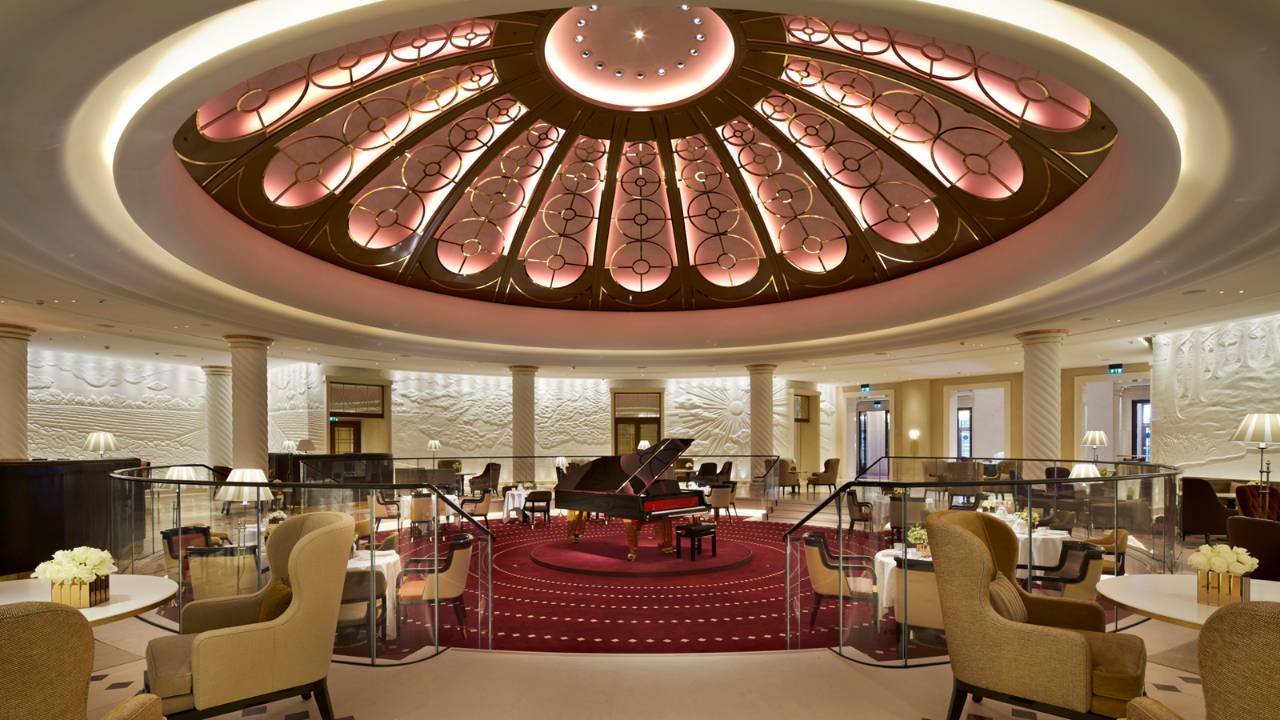

In a landmark of power and prestige, Four Seasons Hotel London at Ten Trinity Square provides a central city location, near the Tower of London, Tower Bridge and the River Thames. The historic building – the 1922 headquarters of the Port of London Authority – also incorporates 41 Private Residences and the Ten Trinity Square Private Club, a prestigious private member's club from Reignwood, Four Seasons Hotels and Chateau Latour.
LAS VENTANAS AL PARAISO
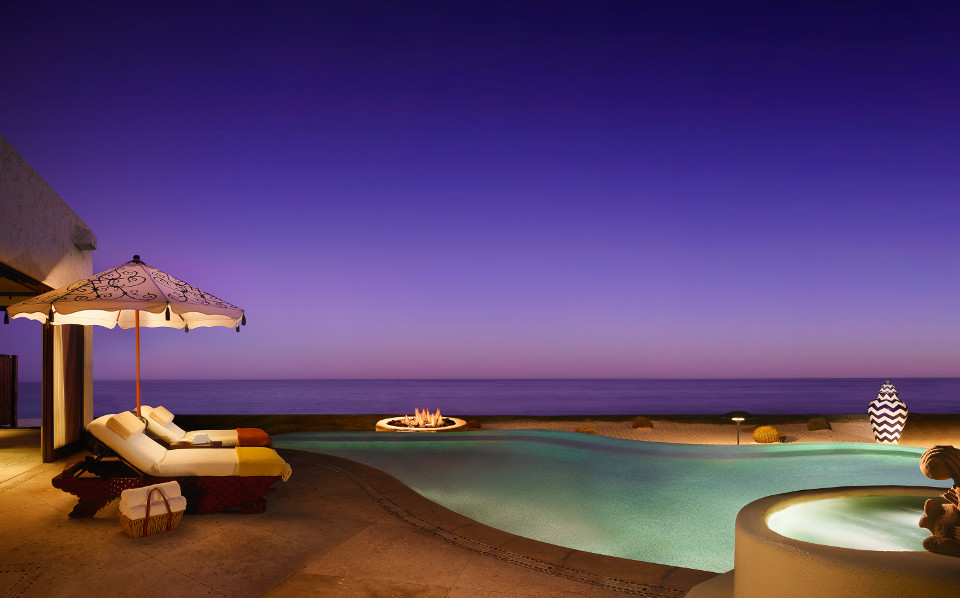



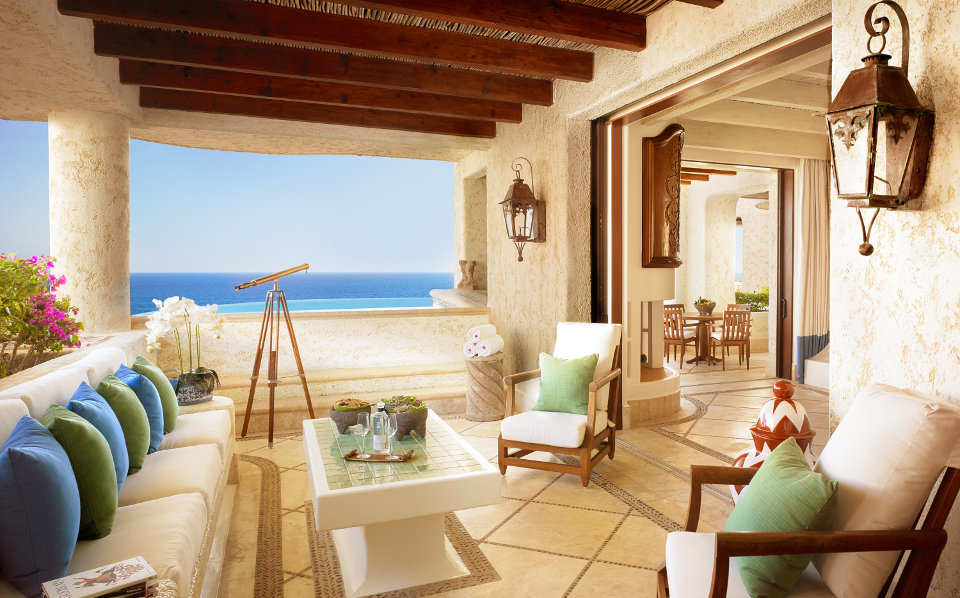
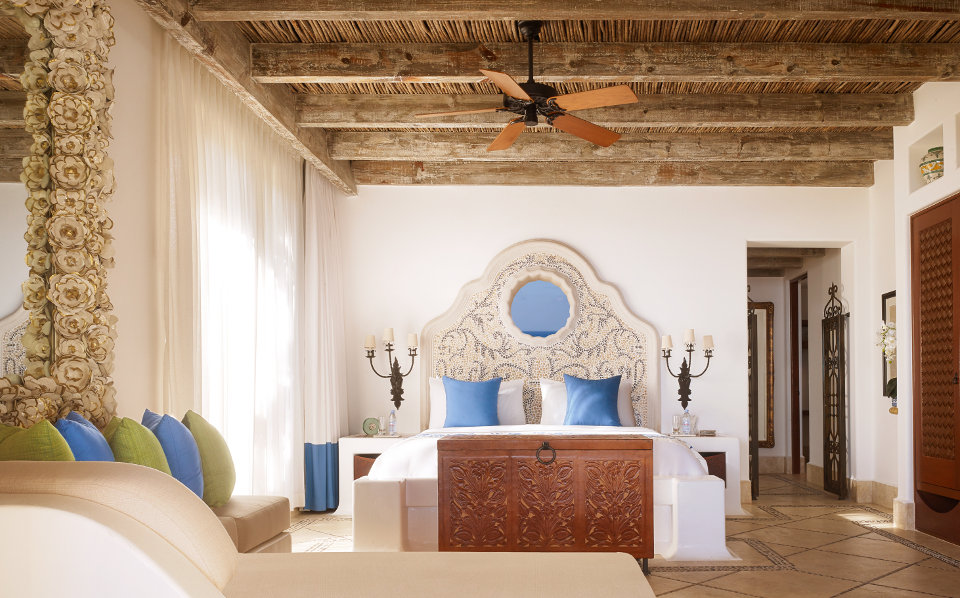
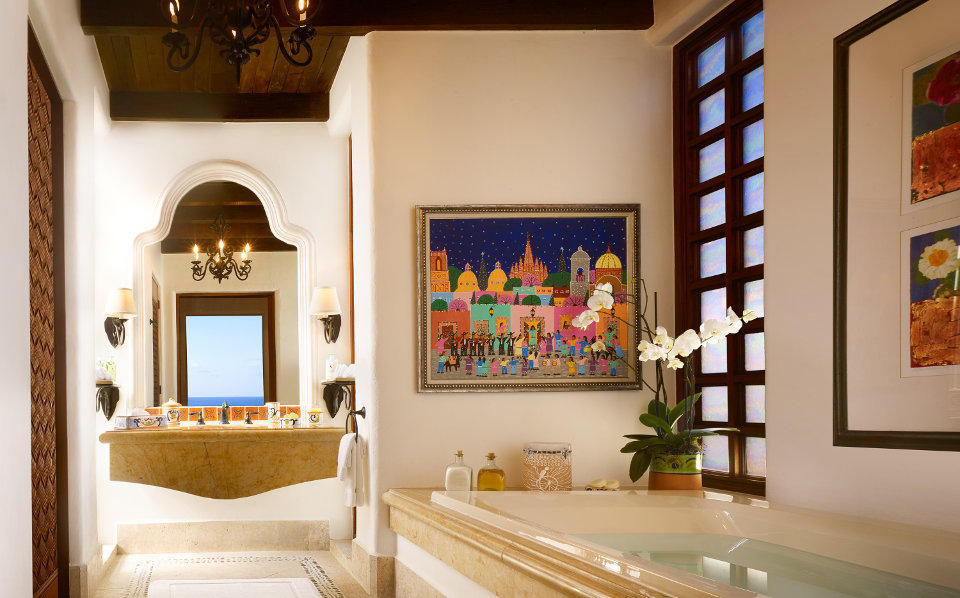


Las Ventanas al Paraíso, A Rosewood Resort’s constant innovation built the resort’s reputation as one of the world’s premier destinations. Since opening in 1997, this desert beach hideaway has captivated guests with expansive suites, inspired cuisine and The Spa at Las Ventanas, the resort's sanctuary of renewal and revitalization. Throughout the resort, pampering and reaching out with special touches are the hallmark of refined hospitality.
The exquisite design of Las Ventanas creates a uniquely beautiful setting for Los Cabos vacations, and the resort’s approach to landscaping is key to its look and feel. Designed to be in harmony and become one with the local ambience, Las Ventanas nestles into the natural slope and contours of the land and the external color scheme reflects the white of the sands and ocean surf.
With respect for the desert-to-ocean terrain and ecology, Las Ventanas avoids non-native tropical foliage, incorporating indigenous plants whose natural requirements and characteristics are appropriate to the local climate. Such varietals include cactus, succulents and other desert plants; many are blooming varieties that splash the resort with many brilliant colors.

The Garden Bar


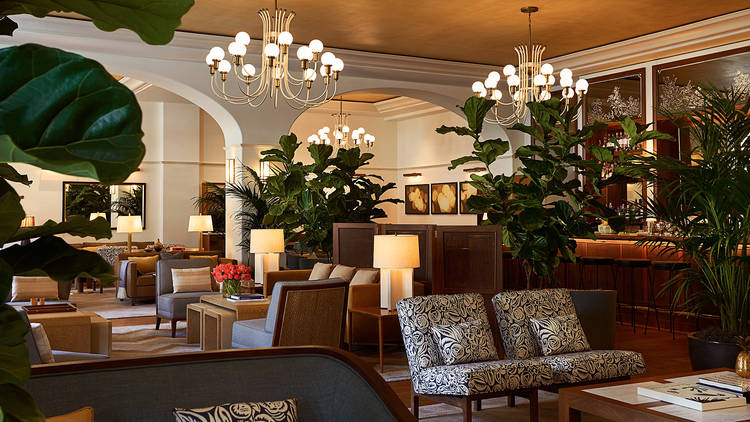

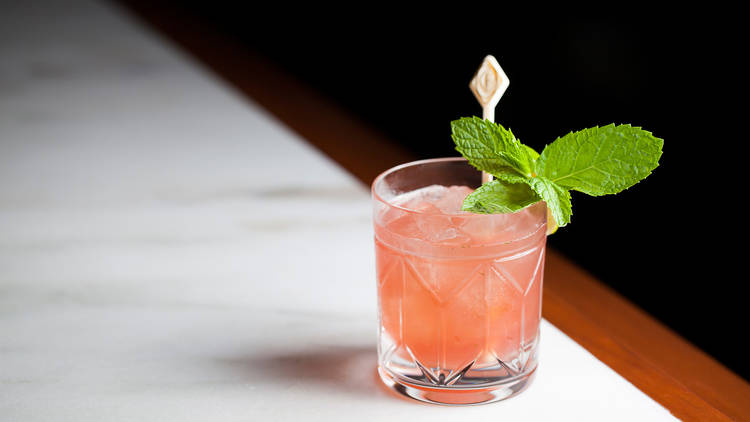
Sure, there’s exotic tea, caviar service, and backgammon. But The Garden Bar, the Montage Beverly Hills’ ground-level lounge, is anything but stodgy. There’s a palpable sense of style from the moment guests step inside: Mid-century modern sofas, posh brass light fixtures, rich finished wood and verdant indoor palms give the former Parq Bar space a chic, contemporary vibe, like you’re visiting the swinging pad of a ‘60s socialite instead of the antiquated abode of a rich ol’ auntie. No stale, contaminated nuts here. Gratis bar food comes in the form of cubed salami and housemade potato chips; in case you weren’t aware, this is Food Network personality and New York chef-superstar Geoffrey Zakarian’s first West Coast joint, and he’s pulling out all the stops. White-jacketed bartenders craft cocktails with only the finest ingredients, which is why the going rate for a sidecar is $22 (made with top-shelf Hennessy VSOP Cognac, if it’s any consolation). You may gawk at the price, but you’ll gawk even more at the bar’s 35-page wine collection covering the globe from British Columbia to the Canary Islands. Sip your crystal glass of Italian orange wine (yes, it’s a thing) as you gaze upon the hoi polloi beyond closed glass doors. You’re so 90210 right now.
By: Danielle Jacoby