
Jean-Michel Basquiat- SANTO 4

“The work Basquiat began in late 1982 signaled a new phase of intensity and complexity that focused on black subjects and social inequities and incorporates a growing vocabulary of popular images and characters…The effect was raw, askew, handmade—a primitive-looking object that recalled African shields, Polynesian navigation devices, Spanish devotional objects, and bones that have broken through the surface skin.” (Richard Marshall, “Repelling Ghosts,” in Exh. Cat., Malaga, Palacio Episcopal de Malaga, Jean-Michel Basquiat, 1996, p. 140)
Emblazoned with frenzied, gestural marks and urgent annotations that reflect the spontaneity of graffiti, Santo 4 is a significant milestone in the inauguration of Basquiat’s certified status as an international art star. It is universally acknowledged that 1982 was the most significant year in the artist's tragically short yet enduringly prolific career. Painted in this seminal moment and belonging to a small number of captivating works created on roughly hewn canvas supports, Santo 4 is a preeminent articulation of Basquiat’s expressionistic force, adept combination of cultural references and impactful iconography.
Created the year after Basquiat’s breakthrough participation in the now-legendary New York/New Wave exhibition at the P.S.1 Contemporary Art Centre, Santo 4 is the perfect encapsulation of the artist’s transition from street to studio. Whilst self-organized exhibitions such as the Lower Manhattan Drawing Show at the Mudd Club gave crucial exposure for the artist, his breakthrough participation in the P.S.1 show and success in the show Public Address at the Annina Nosei Gallery gave him the critical success that was to bring about a huge turning point in his career. Indeed, it was in this year that Nosei became Basquiat's primary dealer and staged a critically acclaimed solo show of the artist's work. Using Nosei's Prince Street gallery basement as his studio, Basquiat forged influential links with Bruno Bischofberger and Larry Gagosian. Subsequently, his rise to stardom was astoundingly accelerated: exhibited alongside Gerhard Richter, Joseph Beuys, and Cy Twombly he became the youngest artist to have ever participated in Documenta in Kassel, heralding 1982 as the definitive year in his sudden yet pervasive invasion of the art world. Looking back on this astonishing year, Basquiat recalled, "I made the best paintings ever." (Jean-Michel Basquiat cited in Richard Marshall and Jean-Louis Prat, Jean-Michel Basquiat, Paris 2000, p. 202)
Not only did 1982 bring about extraordinary critical success for Basquiat, it also saw the birth of a celebrated corpus of works stretched over jutting corner supports and exposed stretcher bars. Basquiat and his assistant at the time set about crafting stretchers and frames out of a whole host of found materials such as carpet tacks, rope, canvas and wooden mouldings. Insouciant and purposefully rudimentary, these structures physically dismantle and imbue the grand tradition of painting on canvas with the tribal and primitive, while also referencing a grander art historical tradition of assemblage and collage most influentially advanced in postwar American art by figures such as Robert Rauschenberg.
While the evocation of primitive art very much alludes to Basquiat’s ethnic heritage - born to Puerto Rican and Haitian parents and brought up in Brooklyn, Basquiat's art habitually draws on his triangular cultural inheritance – the artist was also intensely influenced by Picasso for whom primitivism was an antidote to the conservatism of the academies. Similarly, Basquiat finds in primitivism a correlative mode for expressing an overtly contemporary angst simultaneously tied to his own racial identity and his position as an artist responding to the cool minimalism that permeated the gallery scene in Manhattan during the early 1980s.
Dominated by a large skeletal figure surrounded by a medley of scribbled marks and scrawled annotations – emblematic of Basquiat's polemic urban iconography – Santo 4 is demonstrative of the very best of the artist’s celebrated practice. His use of the iconic skeleton motif is both formally and symbolically crucial. Whilst the skull acutely references modernist abstraction and Picasso’s engagement with African art, it also engages with Basquiat’s own identity as a black subject seeking expression within a seemingly ‘white-washed’ art world. As surmised by cultural theorist Dick Hebidge "… in the reduction of line into its strongest, most primary inscriptions, in that peeling of the skin back to the bone, Basquiat did us all a service by uncovering (and recapitulating) the history of his own construction as a black American male." (Dick Hebidge, ‘Welcome to the Terrordome: Jean-Michel Basquiat and the Dark Side of Hybridity’, in Exh. Cat., New York, Whitney Museum of American Art, Jean-Michel Basquiat, 1993, p. 65) Reduced to its skeletal framework the figure also purports Basquiat’s scientific interest in the anatomical makeup of human beings, a subject that had fascinated the artist from an early age. His mother gave him a copy of Grays Anatomy, when, after being hit by a car at the age of seven, he spent a month recovering in hospital. The anecdotal genesis of this interest was further substantiated when Basquiat discovered Leonardo da Vinci's pioneering studies of the human body. Furthermore, the rich assemblage of caricatured faces, arrows and scribbled phrases, which include a childlike sketch of an airplane in the left centre of the composition, recalls the urban iconography of the artist's SAMO days. Ubiquitous to the metropolitan environment of New York, crudely articulated images of cars and planes recur throughout his early work. Along with the words Tokyo, South Korea and Peking, the plane contributes to the global mood that pervades the present work and concurrently symbolises the artist’s growing international success.
Rife with Basquiat’s rich, multi-faceted iconography, Santo 4 imports a dense narrative steeped in symbolic potency. Belonging to Basquiat’s trailblazing group of stretcher paintings, it reflects the nascent global excitement surrounding the artist at the time and acts as a bold proclamation of his inauguration into art history. Rene Ricard, one of the artist’s most notorious critics, singled out this revolutionary body of work and proclaimed: “For a while it looked as if the very early stuff was primo, but no longer. He’s finally figured out a way to make a stretcher… that is so consistent with the imagery… they do look like signs, but signs for a product modern civilisation has no use for.” (Rene Ricard cited in Phoebe Hoban, Basquiat: A Quick Killing in Art, London 2008, p. 105)
Jean-Michel Basquiat "ANTAR"
“He reproduces on the canvas the abstract figural power of his experience, the declarative and narrative temperament, the explicit and didactic strength, the confused condition and the spontaneous aggression of visual elements.” (Achille Bonito Oliva in Exh. Cat., Naples, Castel Nuovo, Basquiat in Naples, 1999, p. 25)
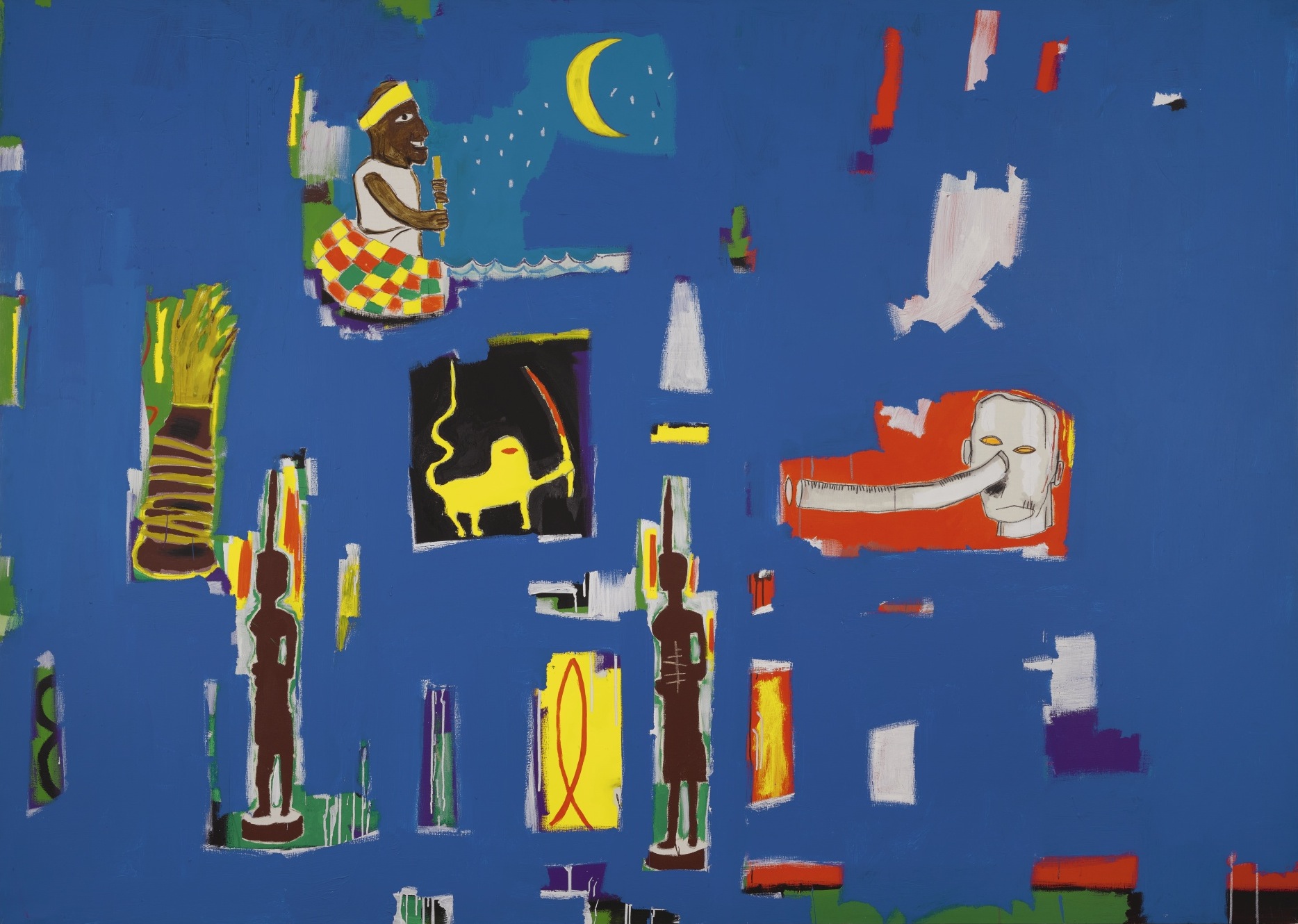
In its dominating scale, compositional intensity, expressionistic force, and deft engagement with art history, politics and race, Antar is demonstrative of the very best of Jean-Michel Basquiat’s celebrated practice. Masterfully distilling the quintessence of socio-cultural concerns and vibrant stylistic techniques, Antar utterly characterizes his works of the mid-1980s. The present work calls forth elaborate iconographies from ancient cultures, with primitive sculptures, masks and a canoeing tribal figure encircling a savage mythical creature, wielding a bloodied spear. Referencing the mythical figure of Antar, the pre-Islamic Arabian knight and poet whose legacy as a warrior and intellectual is recounted throughout Arabic literature and visual arts, Basquiat draws on a host of pre-historic references to paint an expansive canvas rich in symbolic imagery and allegorical content. Via an astounding pluralistic command of art historical vernacular that synthesizes graffiti, primitivism and Abstract Expressionism, Basquiat presents a powerful racial dialectic as a palimpsest of post-modernity. Indeed, such intense erudition is authoritatively delivered by an unsurpassed magnificence of surface manipulation. Streaming drips of acrylic and viscous clumps of oil stick lyrically coalesce to create an exuberant and formally stunning masterwork that posits Antar among the most painterly of Basquiat's entire production.
Antar was created at a moment when Basquiat had reached an absolute pinnacle of celebrity and recognition, following his rapid rise to artistic prominence in 1981 when his works were first exhibited in public. Born into a regular working family in Brooklyn, New York, at the age of seventeen Basquiat dropped out of school and moved to Manhattan’s spirited Lower East Side. With few resources other than sheer determination, within just four years the young artist progressed from intermittent bouts of homelessness and the ubiquitous dissemination of his ‘SAMO’ graffiti tag across the city, to being introduced to an enamoured art world as ‘The Radiant Child’ through René Ricard’s seminal Artforum article of December 1981. Represented in 1985 by two of the leading gallery owners of the day, Bruno Bischofberger and Mary Boone, Basquiat’s paintings attracted almost hysterical acclaim when exhibited, and seemed to epitomise the cultural zeitgeist of 1980s New York, a city unabashedly dominated by conspicuous consumption. Basquiat’s dominance and conquest of the New York art world was reinforced by his presence on the cover of ‘The New York Times Magazine’ on February 10 1985, accompanied by an effusive article written by Cathleen McGuigan. McGuigan declared: “The extent of Basquiat’s success would no doubt be impossible for an artist of lesser gifts. Not only does he possess a bold sense of colour and composition, but… he maintains a fine balance between seemingly contradictory forces: control and spontaneity, menace and wit…” (Cathleen McGuigan cited in Exh. Cat., New York, Whitney Museum of American Art, Jean-Michel Basquiat, p. 246) McGuigan’s reference to ‘menace and wit’ appears particularly apposite in the case of Antar, in which the seemingly threatening nature of the facial expressions of the red eyed mask and ferocious mythical beast are brilliantly countermanded by the element of humor conveyed by the floating canoeing man whose face is plastered with an unerring grin.
In many ways, Basquiat’s extraordinary reinterpretation of figuration represents a critical retort to the intellectualized currents of Minimalism that permeated the Manhattan gallery scene during the early 1980s. Basquiat explained in 1985: “The art was mostly minimal when I came up and it sort of confused me a little bit. I thought it divided people a little bit. I thought it alienated most people from art.” (Jean-Michel Basquiat cited in Exh. Cat., Basel, Fondation Beyeler, Jean-Michel Basquiat, 2010, p. XXIII) Basquiat forged an aesthetic that combined a Pop integration of comic book imagery with gestural abstract passages very much attuned to a contemporaneously outmoded high-art language of Abstract Expressionism. Possessing a sophisticated knowledge of art history Basquiat infused his painting with a defined instinctual understanding of the language of abstraction. In the present work forceful painterly strokes are deployed with an assured command, over which layers of erased, painted over and liberally confident mark making recast an innovative symphony of abstract expressionism’s pictorial vernacular. Basquiat commands, combines and synthesizes these paradigms of American art with spectacular faculty: the schematic background, great swathes of deep blue, red and green are laid down with intense, gestural brushwork. The artist's brute force of application and layering of paint and line through brush and oil stick confers a remarkably paroxysmal yet deliberate harmony via a structural and exuberant formalism. There is no spatial recession or perspectival logic to the composition; form and ground mesh together to confer an implosion of form to pure energy. Imbued with the frantic exertion and the poured, dripping aesthetic of Jackson Pollock; combined with the exuberant colorism and dramatic painterly gesture of Willem de Kooning and Franz Kline, Basquiat's grasp and deployment of Twentieth Century American art history is impressive and manifold. With the present work, Basquiat deftly weaves the machismo painterly attitude of Kline in the expansive and expressive gestural blue background with ethereal Twombly-like ciphers of line.
Of Puerto Rican and Haitian descent, and raised in Brooklyn, Basquiat drew from his manifold ancestral background and racial identity to forge a body of work acutely conscious of his contribution to the meta-narrative of an almost exclusively white Western art history. Basquiat aligned himself stylistically with Picasso, for whom primitivism was an antidote to the conservatism of the academies. Painterly elements extrapolated from the early Twentieth-Century master’s canon of abstraction and treatment of line thread a course throughout his oeuvre. Spanning Picasso’s Cubist undoing of the figure, through to the ground-breaking African Period, Basquiat masterfully quotes and re-appropriates. In the present work, such a reading is certainly at stake within the twisting application of line and stuttering dynamism of its composition, whilst, the mask-like figure undoubtedly evokes the kind of tribal masks apparent in Picasso’s masterwork, Les Demoiselles d’Avignon (1907) and his abstracted Self Portrait (1906). Basquiat found in primitivism a correlative mode for expressing an overtly contemporary angst tied to his own black identity, embodying his projected “blackness,” while subverting these very identity constructions by emulating Western conventions of painting.
Sophisticated, confident and radiating a conviction of artistic vision, the extraordinary visual power of Antar is a sheer testament to the thriving talent of a young and brilliant artistic spirit who, by 1985, had truly secured his position at the vanguard of an artistic consciousness. The present work solidified Basquiat as a figure who dashed effortlessly between art historical precedents in order to create a wholly individual painting deeply suffused with personal history, memory and emotion.